The flagship roundup
The best tool chests, ranked on what the maker actually publishes
Not on feel, not on finish, and not on a testing program we did not run. On the four numbers that predict whether a box survives being loaded: gauge, slide rating, volume and weight.

The Husky 56 in. 18-drawer set is the pick, because it is the one widely available listing that publishes a gauge (19), a per-drawer rating (120 lb), a total capacity (3,000 lb) and an empty weight (604 lb) all at once - and those four numbers are consistent with each other. If your bay is smaller, the Milwaukee High Capacity 46 in. cabinet publishes 18-gauge steel and 2,500 lb - though note it is a different box from the 20-gauge 8-drawer Milwaukee that shares the width. Which is which.
How this list was put together
There is no test rig behind this page and there is no lab. What there is: the published specification for every box below, read off the maker's own listing, converted into comparable units, and checked for internal consistency. That last part turns out to matter more than it sounds - a listing quoting a 3,000 lb capacity across drawers rated at 75 lb a pair is telling you something about how carefully it was written.
Where a figure is absent, the entry says Not published rather than filling in a plausible number. In this category that absence is itself a finding, and about a third of the 56-inch cabinets on Amazon publish no body gauge at all.
Quick picks
Ranked on published specifications, not on hype. The key number is the figure that decides each pick, quoted from the maker. Tap a row for the full write-up, or go straight to the listing.
| # | Product | Best for | Key number | Price |
|---|---|---|---|---|
| 1 | HuskyNo photo Husky 56 in. 18-drawer comboStill the most completely documented 56-inch combo in the category - 19-gauge body, 120 lb soft-close drawers, 3,000 lb rated, 604 lb empty on six 5 x 2 in casters, all published in one place. The catch as of September 2026 is the route: the Amazon listings have lapsed and it is a Home Depot purchase. | The one-and-done garage upgrade, if you can get to a Home Depot | 19 gabody steel | Check price on Amazon |
| 2 | 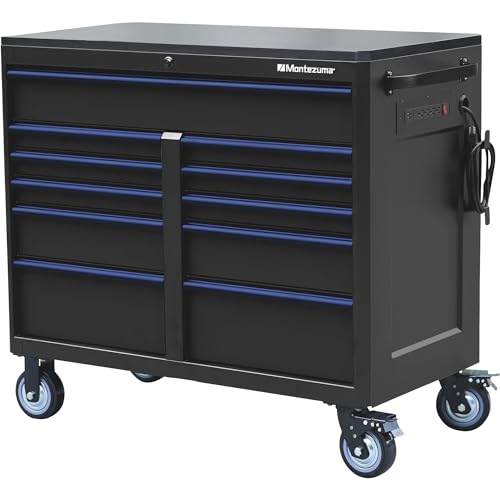 Montezuma 46 x 24 11-drawer150 lb per drawer pair is the highest published slide rating on this site - 30 lb a drawer more than the Husky and 50 more than most of the field, which at the standard 80 percent design guidance is 120 lb of working load. Montezuma builds 20-gauge and publishes it, and this is the width that is actually in stock. | The heaviest published drawer rating on this site | 150 lbper drawer pair | $1,529.99 · Check on Amazon |
| 3 |  Milwaukee 46 in. 8-drawer cabinetMilwaukee's standard 46-inch cabinet, not a High Capacity unit - and the distinction is worth 1,800 lb against 2,500, 20 gauge against 18, and 18 inches of depth against 22. It is the one of the two that reliably has an Amazon listing. | The 46-inch cabinet that is actually on Amazon | 1,800 lbpublished capacity | $2,600.00 · Check on Amazon |
| 4 |  56 in. 10-drawer cabinetPublishes 150 lb soft-close slides and a 3,000 lb-plus total across 23,583 cubic inches, but no body gauge - which is the single most useful number in the category and its absence is worth weighing. | Volume per dollar at 56 inches | 23,583 cu instorage volume | $2,200.00 · Check on Amazon |
| 5 | CraftsmanNo photo Craftsman S2000 52 in. chestCraftsman publishes an 18-20 gauge I-frame rather than a single figure, which is a real answer and an annoying one: the frame is thicker than the panels. At 16 in deep it is the shallow option here, which is a virtue in a narrow garage and a limit everywhere else. | A shallow bay where 22 inches of depth will not fit | 16 indepth | Check price on Amazon |
| 6 |  LARBANKE 56 in. comboAn Amazon-native 56-inch combo with a power outlet and eighteen drawers, and essentially no published engineering data. That does not make it bad; it makes it unverifiable, and we would rather say so than fill the gaps in. | The cheapest route to eighteen drawers | 18drawers | $1,499.99 · Check on Amazon |
Every key number is a figure the manufacturer publishes. Where a maker publishes none, the row says so rather than substituting an estimate of ours.
Top pick · The one-and-done garage upgrade, if you can get to a Home Depot
Husky 56 in. 18-Drawer Professional Tool Chest and Cabinet Set
Still the most completely documented 56-inch combo in the category - 19-gauge body, 120 lb soft-close drawers, 3,000 lb rated, 604 lb empty on six 5 x 2 in casters, all published in one place. The catch as of September 2026 is the route: the Amazon listings have lapsed and it is a Home Depot purchase.
- Body steel
- 19 ga0.0418 in (1.06 mm)
- Per drawer
- 120 lb96 lb working
- Storage
- 24.8 cu ft42,876 cu in
- Empty weight
- 604 lb101 lb per caster, empty
What works
- Publishes a real body gauge, which most listings in this category simply do not
- 120 lb per drawer is genuinely usable: a full 200-piece socket set is around 24 lb
- Six casters rather than four spreads a 600 lb empty weight over more contact points
- Barrel-key locks on both the chest and the cabinet
What does not
- No live Amazon listing right now, so this is a Home Depot trip rather than a delivery you can order from here
- 604 lb empty is a two-person, ramp-and-straps delivery problem
- Husky is a Home Depot house brand, so availability has always come and gone
- 56 in wide plus caster overhang needs about 5 ft of clear wall
| Published specification | |
|---|---|
| Body steel | 19 gauge |
| Drawers | 18 (6-drawer top chest over a 12-drawer cabinet) |
| Per-drawer rating | 120 lb soft-close; deep bottom drawers run dual glides |
| Total capacity | 3,000 lb |
| Empty weight | 604 lb |
| Storage volume | 42,876 cu in |
| Casters | Six, 5 in x 2 in |
| Power | Two power centers, 6 outlets and 2 USB |
| Where to buy | The Home Depot. No live Amazon listing as of September 2026. |
| Where it is sold | The Home Depot |
Who it is for
Someone buying the last box they intend to buy for a decade, with a garage bay to put it in and a Home Depot they can reach.
What it is not for
Anyone who needs it delivered from an online listing today, or who has less than five feet of wall.
No buy button, on purpose
This is sold through The Home Depot rather than Amazon. There is no affiliate link we can build for it, so there is no button here — and no commercial reason for us to push you toward or away from it. How this site is funded.
Sources for this entry
2 · The heaviest published drawer rating on this site
Montezuma 46 in. x 24 in. 11-Drawer Rolling Tool Cabinet
150 lb per drawer pair is the highest published slide rating on this site - 30 lb a drawer more than the Husky and 50 more than most of the field, which at the standard 80 percent design guidance is 120 lb of working load. Montezuma builds 20-gauge and publishes it, and this is the width that is actually in stock.
- Body steel
- 20 ga0.0359 in (0.91 mm)
- Per drawer
- 150 lb120 lb working
- Storage
- Not published
- Empty weight
- Not published
What works
- 150 lb per pair is the heaviest published drawer rating anywhere on this site
- Full-extension ball-bearing slides, published as such rather than described as heavy duty
- 24 in deep takes a long breaker bar lying flat, which 18 in cabinets will not
- Publishes a body gauge, which about a third of this category declines to do
What does not
- Publishes no total capacity and no empty weight, so the delivery and the caster load are unknowns
- 46 in rather than the 56 in this entry used to cover - the wider listing is no longer sold on Amazon
- Priced well above the 46-inch field it now sits in
- Four casters under a cabinet this deep, where six would spread the load better
| Published specification | |
|---|---|
| Body steel | 20 gauge |
| Dimensions | 46 in W x 24 in D |
| Drawers | 11 |
| Per-drawer rating | 150 lb, full-extension ball bearing |
| Casters | Four |
| Power | Multiple power outlets |
| Total capacity | Not published |
| Empty weight | Not published |
| Where it is sold | Amazon, plus other retailers |
Who it is for
Someone loading drawers heavily enough that a 100 lb rating is the binding constraint.
What it is not for
Anyone who specifically needs 56 inches, or who wants a published total capacity.
3 · The 46-inch cabinet that is actually on Amazon
Milwaukee 46 in. 8-Drawer Rolling Steel Storage Cabinet (48-22-8520)
Milwaukee's standard 46-inch cabinet, not a High Capacity unit - and the distinction is worth 1,800 lb against 2,500, 20 gauge against 18, and 18 inches of depth against 22. It is the one of the two that reliably has an Amazon listing.
- Body steel
- 20 ga0.0359 in (0.91 mm)
- Per drawer
- 100 lb80 lb working
- Storage
- 8.8 cu ft15,160 cu in
- Empty weight
- Not published
What works
- 1,800 lb published total capacity, which is a real figure and a good one at this width
- Angle iron reinforced frame and 5 in industrial casters, both published by Milwaukee
- Pre-cut drawer liners included, which is a genuine cost most makers push onto you
- 46 in fits a single-car bay that a 56 in box does not
What does not
- 20 gauge is 0.0359 in - the budget-default thickness, and thinner than the 18 ga High Capacity line people assume they are buying
- 18 in deep, four inches shallower than the High Capacity cabinet, so long tools sit diagonally
- Milwaukee does not publish a gauge for this model on its own page; the 20 ga figure comes from the retail listing
- 100 lb drawers rather than the 120-150 lb the wider cabinets publish
| Published specification | |
|---|---|
| Model | 48-22-8520, the standard 46 in line |
| Body steel | 20 gauge, per the Amazon listing; Milwaukee does not publish a gauge for this model |
| Dimensions | 46 in W x 18 in D |
| Drawers | 8 - four small, three medium, one large |
| Per-drawer rating | 100 lb soft close |
| Total capacity | 1,800 lb |
| Storage volume | 15,160 cu in (about 8.8 cu ft) |
| Casters | 5 in industrial, fixed and swivel, with a push handle |
| Frame | Angle iron reinforced |
| Locking | Barrel key internal locking system |
| Included | Premium pre-cut drawer liners, built-in power center |
| Where it is sold | Amazon, plus other retailers |
Who it is for
A 46-inch bay, hand tools rather than breaker bars, and a preference for buying online.
What it is not for
Anyone who wanted the 18-gauge Milwaukee. That is the High Capacity 48-22-8542, and it is a different box.
4 · Volume per dollar at 56 inches
High-Capacity 56 in. 10-Drawer Rolling Tool Cabinet
Publishes 150 lb soft-close slides and a 3,000 lb-plus total across 23,583 cubic inches, but no body gauge - which is the single most useful number in the category and its absence is worth weighing.
- Body steel
- Not published
- Per drawer
- 150 lb120 lb working
- Storage
- 13.6 cu ft23,583 cu in
- Empty weight
- Not published
What works
- 150 lb slides match the best published figure among these cabinets
- 13.6 cubic feet is a lot of drawer for the footprint
- Soft close throughout rather than on selected drawers
What does not
- No published body gauge - you are trusting the drawer rating alone
- No published empty weight, so the loaded-caster check cannot be done
- Amazon-native brand with limited service history behind it
| Published specification | |
|---|---|
| Body steel | Not published |
| Width | 56 in |
| Drawers | 10 |
| Per-drawer rating | 150 lb soft-close ball bearing |
| Total capacity | 3,000 lb and up |
| Storage volume | 23,583 cu in (about 13.6 cu ft) |
| Where it is sold | Amazon, plus other retailers |
Who it is for
A buyer optimizing drawer volume per dollar who accepts an unpublished gauge.
What it is not for
Anyone who wants to check the steel before they buy.
Sources for this entry
5 · A shallow bay where 22 inches of depth will not fit
Craftsman S2000 Series 52 in. 8-Drawer Tool Chest (CMST98272)
Craftsman publishes an 18-20 gauge I-frame rather than a single figure, which is a real answer and an annoying one: the frame is thicker than the panels. At 16 in deep it is the shallow option here, which is a virtue in a narrow garage and a limit everywhere else.
- Body steel
- 18 ga0.0478 in (1.21 mm)
- Per drawer
- 100 lb80 lb working
- Storage
- 8.1 cu ft14,014 cu in
- Empty weight
- Not published
What works
- 16 in deep fits a bay where a 22 in box would block the car door
- Publishes a storage volume, which makes it comparable rather than adjectival
- The I-frame spec is honest about mixed gauges instead of quoting the thickest panel
What does not
- 16 in of depth means long tools sit diagonally or not at all
- 18-20 ga is a range, so the thin end is what the panels actually are
- Top chest only - this is not a floor-standing box
| Published specification | |
|---|---|
| Body steel | 18-20 gauge steel I-frame construction (as published) |
| Dimensions | 51.5 in W x 16 in D x 24.5 in H |
| Drawers | 8 |
| Per-drawer rating | 100 lb |
| Storage volume | 14,014 cu in (about 8.1 cu ft) |
| Power | Integrated power strip with USB |
| Where it is sold | Amazon, plus other retailers |
Who it is for
A narrow garage, a bench top, or a second chest for shallow hand tools.
What it is not for
Torque wrenches and breaker bars, which need depth this box does not have.
Sources for this entry
6 · The cheapest route to eighteen drawers
LARBANKE 56 in. 18-Drawer Tool Chest and Cabinet Combo
An Amazon-native 56-inch combo with a power outlet and eighteen drawers, and essentially no published engineering data. That does not make it bad; it makes it unverifiable, and we would rather say so than fill the gaps in.
- Body steel
- Not published
- Per drawer
- Not published
- Storage
- Not published
- Empty weight
- Not published
What works
- Eighteen drawers and a 56 in footprint at the low end of the price band
- Built-in outlet, which is a genuine convenience on a garage box
What does not
- No gauge, no slide rating, no capacity, no weight: nothing to check
- Amazon-native brand with no manufacturer spec sheet to fall back on
- Without a slide rating you cannot tell whether a drawer will hold a socket set
| Published specification | |
|---|---|
| Body steel | Not published |
| Width | 56 in |
| Drawers | 18 |
| Per-drawer rating | Not published |
| Power | Integrated power outlet |
| Where it is sold | Amazon, plus other retailers |
Who it is for
A budget that will not stretch to a spec-published box, eyes open.
What it is not for
Anyone who intends to load drawers heavily - with no published rating there is nothing to load them against.
Sources for this entry
How we picked
- Does the maker publish a body gauge? A box that will not tell you how thick its steel is has made the first decision for us. Boxes that publish rank above boxes that do not, all else equal.
- What are the drawers rated to, per pair? 120 lb and up on a cabinet; anything under 100 lb caps what a deep drawer is actually for.
- Is there a published volume in cubic inches? It is the only figure that lets two different drawer layouts be compared. Drawer count is not a substitute.
- Is there a published empty weight? Without it you cannot check what the casters are carrying, which is the failure mode nobody writes about.
- Can you actually buy it? A recommendation you cannot act on is a magazine article. Where the best answer is a store-exclusive, we say so and name a spec-matched alternative.
What we did not do
Everyone in this category says they spent seventy-five hours testing tool chests. We have not opened any of these boxes, and we say so. What we do instead: compile the published specs, convert the steel gauges, multiply out the slide ratings, cite the maker’s own listing, and show the arithmetic so you can check it. The full method, including how to challenge a figure.
What we would skip
A list with no losers is a list nobody edited. These are the choices we would actively steer you away from, and why.
Any 56-inch cabinet that publishes no gauge and no slide rating
There are a lot of them and they photograph identically to the ones that do. Without either number there is nothing to check before you load it, and the first time you find out is when a full drawer starts to sag. If the price gap is small, buy the one that published its specs.
A top chest as your first purchase
A top chest on the floor is a box at the wrong height with shallow drawers. Buy the rolling cabinet first - deep drawers on rated slides are the part you cannot improvise - and add the chest later. It will still bolt on.
Buying on drawer count
Eighteen shallow drawers and eleven deep ones can hold exactly the same tools, and the eleven will hold them better. Convert the published volume instead: 42,876 cubic inches is 24.8 cubic feet, and that number is comparable across layouts in a way that a drawer count never is.
One brand needs a caveat before you compare it to anything: Milwaukee sells two separate 46-inch lines whose published gauges and capacities are not the same, and a listing will call both of them the same thing. We untangle them here.
The gauge question, settled quickly
Gauge is the number people argue about and it deserves about two minutes of your attention. It is a weight-derived index, not a measurement, which is why it counts backwards and why the steps are uneven. 19 gauge is 0.0418 in of steel; 20 gauge is 0.0359 in. That is a 16 percent difference in thickness between two adjacent-sounding numbers, and 18 gauge is 33 percent thicker than 20.
What it buys you is resistance to racking - the box staying square when it is loaded to several hundred pounds and pushed across a garage floor with an expansion joint in it. It does not make drawers hold more; that is the slides. The full conversion table is on the gauge page.
The drawer question, which matters more
A drawer slide rating is published per pair, at full extension, and the published design guidance is to run at 70 to 80 percent of it. So a drawer described as 120 lb is a 96 lb drawer in practice, and a 75 lb drawer is a 60 lb drawer. A 200-piece mechanic's socket set weighs around 24 lb; a half-inch impact socket set is around 18 lb; hammers and pry bars together will run you 14 lb. It adds up faster than people expect.
This is the number that actually fails. Overload a slide and it does not snap - it sags at full extension, then binds, then the bearings brinell and the drawer starts dropping at the front. Run your own heaviest drawer through the arithmetic before you decide 100 lb is enough.
What about U.S. General, ICON and Kobalt?
They are not on this list, and the reason is availability rather than quality. U.S. General and ICON are Harbor Freight exclusives; Kobalt is a Lowe's house brand. None of them can be bought through any affiliate channel and none can be shipped to you from a link on this page. That does not make them bad - a U.S. General Series 3 cabinet from a store nearby is frequently the right purchase.
What we do instead of pretending otherwise: cover them properly in the comparison hub, state plainly that we earn nothing, and name a spec-matched alternative you can have delivered. U.S. General vs Husky is the page most people are actually looking for.
Sizing it to your garage, not to your tools
And if what you actually need is a box that leaves the garage rather than one that fills it, portable tool boxes is the other category - judged on published capacity and IP rating rather than on gauge and slide ratings.
Almost everyone buys one size too big for their space and one size too small for their tools, in that order. The width on the listing is the cabinet only - it excludes the caster overhang and any side handle, so a 56-inch box wants about five feet of clear wall and enough room to stand beside it with a drawer out.
If that is not your garage, the 46-inch page is the honest section to read, and Milwaukee publishes 18-gauge steel at that width on its High Capacity line - thicker than most of the 56s. If it is, the 56-inch page covers the size properly. For the heaviest published drawer ratings in either size, Montezuma is the specialist worth knowing about.
And the half a chest cannot do
Drawers hold tools. They do not hold the cases the tools came in, a five-gallon pail, or a stack of cordless kits - and trying to make a chest do that is how people end up with a box that will not close. Tool storage cabinets is the door-and-shelf half of the same garage, judged on published shelf capacity rather than on gauge and slide ratings. If the box you own is simply full, side cabinets and hutches covers what bolts onto it and what almost none of them will tell you.
Common questions
What is the best tool chest for a home garage?
For most home garages, a 46 or 56 inch rolling cabinet in 18 or 19 gauge steel with drawers rated at 120 lb per pair or better. The Husky 56 in. 18-drawer set is the pick here because it publishes gauge, per-drawer rating, total capacity and empty weight together, and the four figures are consistent.
How many drawers do I actually need in a tool chest?
Fewer than you think, and deeper. Drawer count is the least useful spec on the listing - eighteen shallow drawers and eleven deep ones can hold the same tools. Compare published volume in cubic inches instead, and divide by 1,728 to get cubic feet. How boxes are measured.
Is 19 gauge good for a tool chest?
Yes, for a consumer cabinet. 19 gauge is 0.0418 in - thicker than the 20 gauge most budget cabinets use, and only slightly thinner than the 18 gauge Milwaukee publishes on its High Capacity line. The gauge table.
Do I need a combo set or just the rolling cabinet?
Buy the cabinet first if you are buying one thing. Deep drawers on rated slides are what you cannot improvise; a top chest can be added later and will still bolt on. Combo sets are usually cheaper than buying both separately, so if you know you want both, buy them together. Chest vs cabinet.
Sources
- The Home Depot - Husky 56 in. 18-drawer combination set (HOTC5618BD1S)
- Milwaukee - 46 in. High Capacity 8-drawer chest specification (48-22-8541)
- Montezuma - 46 x 24 in. 11-drawer cabinet specification
- Sheet metal gauge chart, standard steel (gauges 14-24)
- Drawer slide load capacity guide - ratings are per pair, design to 70-80%
Read next
Replacing a tool box drawer slide, and matching the rating it had
A drawer that drops or grinds needs a slide, not a new box - how to match length, mount and rating, and which replacements publish one.
Kobalt vs Craftsman tool chest: same width, 6.5 inches apart
Two 41-inch cabinets on the same Lowe's shop floor, separated by 6.5 inches of depth and by which one publishes a steel gauge.
Rolling tool boxes, and the two very different things that phrase means
Job-site cases and shop cabinets are both sold as rolling tool boxes. The specs that decide them are completely different, and here is each.
The best tool box brands, and the ones you cannot actually buy online
Which tool box brands publish real specifications, which are store exclusives you cannot order, and why the badge matters less than the model number.
How to choose a tool chest: five numbers, in order
Five published numbers, in the order they should knock options out, with the arithmetic for each shown in full.
56-inch tool chests, and the five feet of wall they really need
What a 56-inch cabinet really needs in floor space, what the width figure excludes, and the ones worth buying on published specs.
46-inch tool chests, the size that fits an actual garage
The size that fits a single-car bay with the car in it - and where 18-gauge steel is actually available.
Tool box steel gauge, converted into something you can use
Every gauge used in tool storage converted to inches and millimeters, why the numbers run backwards, and what thicker steel actually buys.
What your drawer actually weighs, and what the box weighs full
The calculator for your own heaviest drawer, published tool weights, and the loaded-box figure no manufacturer prints.
U.S. General vs Husky tool chests, including where you can actually buy each
The most-searched matchup in the category, decided by buying channel as much as by steel - with a table saying plainly what we earn on each.