Reference
Tool box steel gauge, converted into something you can use
Gauge is not a unit and it does not measure anything directly. It is a weight-derived index, which is why it counts backwards and why nobody can convert it in their head.
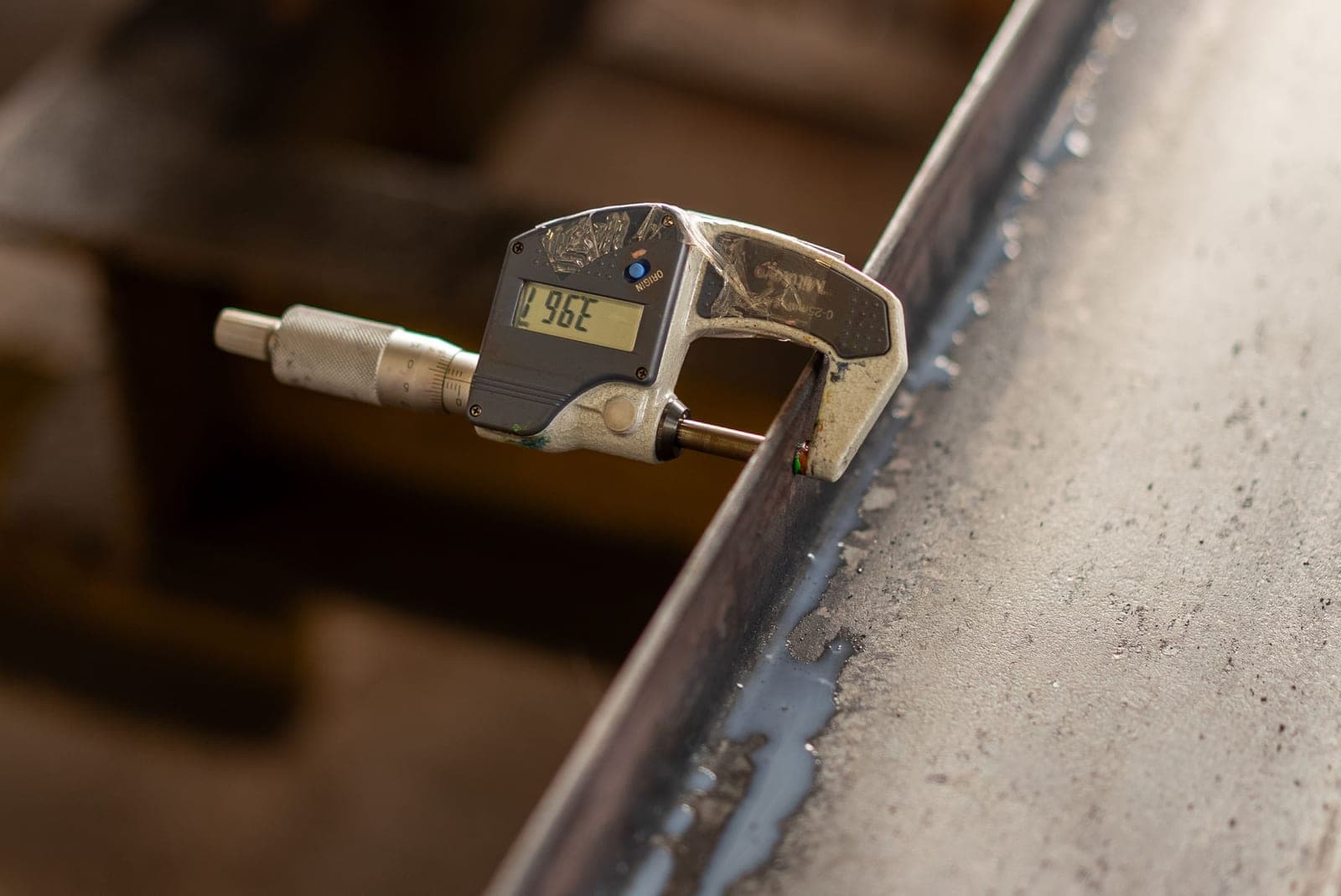
18 gauge is 0.0478 in. 19 gauge is 0.0418 in. 20 gauge is 0.0359 in. So 18 gauge is about 33 percent thicker steel than 20 - a far bigger difference than two adjacent numbers suggests. Lower gauge means thicker metal, because the standard is derived from weight per square foot rather than from a measurement.
Why the numbers run backwards
Sheet steel gauge comes from the Manufacturers' Standard Gauge, which is defined by weight: the standard is anchored on 41.82 pounds per square foot per inch of thickness. Gauge numbers were originally a count in a drawing process, and the practical result is an index where a bigger number means thinner metal and the steps between numbers are uneven.
That unevenness is the part that catches people out. The gap between 18 and 19 gauge is 0.0060 in; the gap between 21 and 22 is 0.0030 in. Two numbers apart at the thick end of the range is a much larger difference in steel than two numbers apart at the thin end, so you cannot reason about gauge proportionally.
| Gauge | Inches | Millimeters | Vs 20 gauge | Where you see it |
|---|---|---|---|---|
| 14 ga | 0.0747 in | 1.90 mm | +108% thicker | Industrial and dealer-truck boxes |
| 16 ga | 0.0598 in | 1.52 mm | +67% thicker | Heavy professional cabinets |
| 17 ga | 0.0538 in | 1.37 mm | +50% thicker | Upper end of consumer heavy duty |
| 18 ga | 0.0478 in | 1.21 mm | +33% thicker | The thickest gauge mainstream brands publish |
| 19 ga | 0.0418 in | 1.06 mm | +16% thicker | Common on 56 in combo sets |
| 20 ga | 0.0359 in | 0.91 mm | reference | The default budget cabinet body |
| 21 ga | 0.0329 in | 0.84 mm | -8% thinner | Thin panels on light cabinets |
| 22 ga | 0.0299 in | 0.76 mm | -17% thinner | Portable boxes and drawer bottoms |
Thicknesses are the Manufacturers' Standard Gauge for sheet steel. The comparison column is computed against 20 gauge, the most common budget tool-box body.
What thicker steel actually buys you
One thing, mostly: resistance to racking. A tool cabinet is a box made of thin panels, and when you load it to several hundred pounds and push it across a garage floor with an expansion joint in it, the box wants to go out of square. Thicker panels resist that. A racked cabinet is how drawers start rubbing, why they stop closing flush, and why an old cheap box feels loose in a way a new one did not.
What gauge does not determine is drawer capacity. That is entirely the drawer slides, and it is a separate spec that can be good on a thin box or bad on a thick one. A 20-gauge cabinet with 150 lb slides holds more in a drawer than an 18-gauge one with 100 lb slides, and both facts are true at once.
Read the absence, not just the number
Roughly a third of the 56-inch cabinets on Amazon publish no body gauge at all. That is not proof of thin steel, but in a competitive market makers with a good number tend to print it - and a listing that gives you a drawer rating, a capacity and a volume while omitting the gauge has made a choice about which numbers help it.
What the mainstream brands publish
| Published | Gauge | Thickness |
|---|---|---|
| Milwaukee High Capacity line | 18 gauge | 0.0478 in (1.21 mm) |
| Husky 56 in. 18-drawer set | 19 gauge | 0.0418 in (1.06 mm) |
| Montezuma 46 in. cabinets | 20 gauge | 0.0359 in (0.91 mm) |
| Craftsman S2000 chests | 18-20 gauge I-frame | A range: the frame is thicker than the panels |
Craftsman's answer is worth noting. Publishing a range rather than a single figure is more honest than quoting the thickest panel, and it tells you the frame and the skin are different - which is true of most cabinets and stated by very few.
Gauge on a workbench top is a different question
The same table applies but the stakes change. On a cabinet body, gauge is about racking. On a steel bench top, it is about whether a dropped socket dents the surface you work on. 14 gauge at 0.0747 in is a top you can hammer on; 20 gauge at 0.0359 in is a top that shows every impact permanently.
Also worth knowing: some steel bench tops are a thin steel skin over particleboard rather than plate. A skin dents permanently and cannot be flattened. Workbench tops covers the distinction.
How to use this when you are shopping
- Find the gauge on the listing. If it is not there, note that.
- Convert it from the table above so you are comparing thicknesses, not index numbers.
- Compare it to 20 gauge, which is the budget default, using the percentage column.
- Then look at the drawer rating separately, because gauge and drawer capacity are independent. Drawer slides.
Common questions
Is 18 gauge or 20 gauge steel thicker?
18 gauge, and by more than the numbers suggest. 18 gauge is 0.0478 in and 20 gauge is 0.0359 in, so 18 gauge is about 33 percent thicker steel. Lower gauge numbers mean thicker metal because the standard is derived from weight per square foot.
What gauge steel is a good tool box?
18 or 19 gauge for a consumer rolling cabinet. 20 gauge is the budget default and works, but it is measurably thinner. What thicker steel buys you is resistance to racking under load, not drawer capacity - that is the slides.
How thick is 19 gauge steel in inches?
0.0418 inches, or 1.06 mm, under the Manufacturers' Standard Gauge for sheet steel. That is about 16 percent thicker than 20 gauge and about 13 percent thinner than 18 gauge.
Why do tool box makers not always publish the gauge?
There is no requirement to. In practice, makers with a competitive figure tend to publish it, so a listing that gives you drawer ratings and capacities while omitting the gauge has made a choice about which numbers help it. Roughly a third of 56-inch cabinets on Amazon publish none.
Sources
- Sheet metal gauge chart, standard steel (gauges 14-24)
- Metal Supermarkets sheet metal gauge chart (cross-check)
- The Home Depot - Husky 56 in. 18-drawer combination set (HOTC5618BD1S)
- Milwaukee - 46 in. High Capacity 8-drawer chest specification (48-22-8541)
- Craftsman - S2000 Series 52 in. 8-drawer chest specification (CMST98272RB)
Read next
The best pegboard for a garage, judged on what it is rated to hold
Metal pegboard compared on published gauge and load limits - 18 gauge against 20, square holes against round, and what a hook is actually rated for.
Ball-bearing drawer slides, and what a rating covers
How the mechanism works, why ratings are per pair at full extension, what the capacity tiers mean, and the four stages of failure.
Workbench tops: thickness first, then material
Why thickness beats material, the five surfaces compared, and the vise-mounting check that is not retrofittable.
The best tool chests, ranked on what the maker actually publishes
The flagship roundup: chests and cabinets ranked on published gauge, slide ratings and volume, with three things we would actively skip.
How to choose a tool chest: five numbers, in order
Five published numbers, in the order they should knock options out, with the arithmetic for each shown in full.
U.S. General vs Husky tool chests, including where you can actually buy each
The most-searched matchup in the category, decided by buying channel as much as by steel - with a table saying plainly what we earn on each.