The small stuff
Small parts organizers, and the one that suits how you work
Fasteners are the last thing anyone organizes and the first thing that wastes an hour. Three formats solve it, and they solve genuinely different versions of the problem.
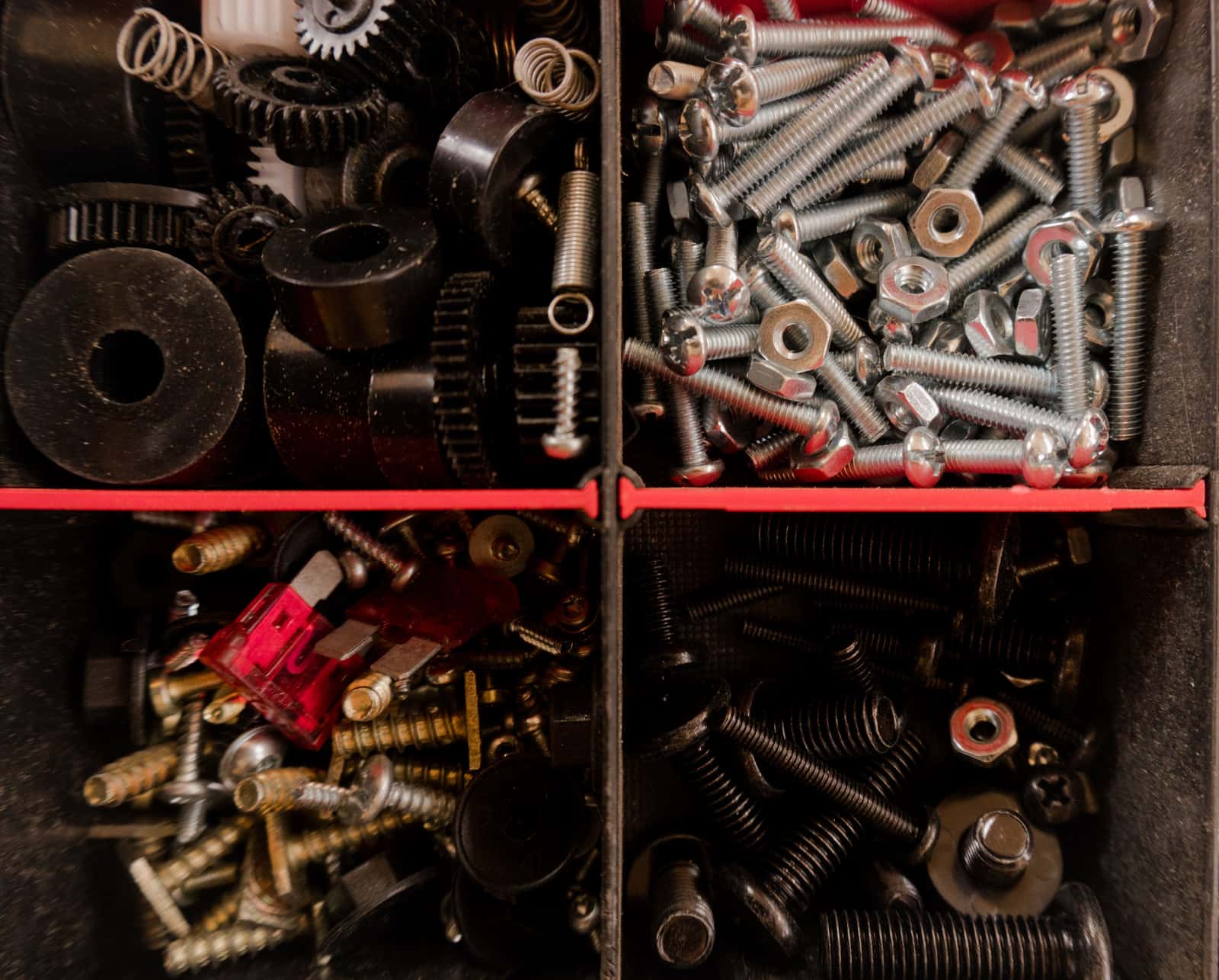
Pick the format by whether the parts travel. Stationary: a 64-drawer cabinet at 20 x 6 x 16 in, wall-mounted, holds more per dollar than anything else here. Traveling: a sealed bin organizer - the PACKOUT compact is IP65 rated with removable bins. Inside a chest drawer: trays, which cost nothing and fix the socket problem.
Three formats, three different problems
This category looks like one shelf in a store and it is really three products. Buying the wrong one is the usual reason people end up with an organizer they stopped using, so it is worth being explicit about which problem each shape solves.
| Format | The problem it solves | What it is bad at |
|---|---|---|
| Multi-drawer parts cabinet | Storing many sizes of one thing permanently, where you can see them all | Traveling. It is a wall fixture with 64 loose drawers |
| Sealed bin organizer | Taking a sorted subset of parts to a job, dry and in order | Volume. Five bins is a fraction of a parts cabinet |
| Compartment box / tray insert | Keeping the contents of a drawer or a carry box from becoming a pile | Being a system. It organizes one container, not a workshop |
Most workshops end up with all three eventually, and in that order. The cabinet is the library, the bin organizer is what you check out of it.
Quick picks
Ranked on published specifications, not on hype. The key number is the figure that decides each pick, quoted from the maker. Tap a row for the full write-up, or go straight to the listing.
| # | Product | Best for | Key number | Price |
|---|---|---|---|---|
| 1 |  Akro-Mils 64-drawerSixty-four clear drawers in a 20 by 6 by 16 inch box that stacks and wall-mounts. It is the cheapest thing on this site that removes an entire category of searching, and the drawers divide again if 64 is not enough. | Fasteners, sorted once and then forgotten | 64drawers | $50.99 · Check on Amazon |
| 2 | MilwaukeeNo photo PACKOUT compact organizerFive removable bins under a transparent sealing lid, IP65 rated, and it clips into the rest of a PACKOUT stack. The bins come out and go to the work, which is the whole point of a small-parts organizer. | Small parts inside a PACKOUT stack | IP65weather seal | Check price on Amazon |
| 3 |  DeWalt TSTAK DWST17804It earns its place on one unusual quality rather than on size: DeWalt publishes a maximum load capacity for it, and most of this category publishes nothing at all. Read the figure before you plan around it, though - 16.5 lb is a drawer of hand tools, not a socket set. | A published capacity in a category that hides them | 16.5 lbpublished load capacity | $34.97 · Check on Amazon |
| 4 | 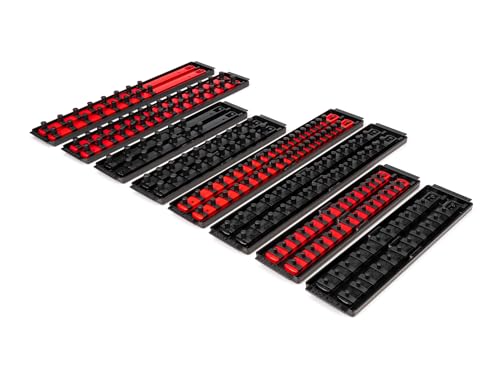 TEKTON socket rail and tray setSockets are the single worst-behaved item in a tool drawer: they roll, they nest, and they all look alike. Rails and trays fix all three, and covering all three drive sizes in one set is what stops the odd drive ending up loose. | Sockets, which are the worst thing in any drawer | 3 drives1/4, 3/8, 1/2 in | $140.00 · Check on Amazon |
Every key number is a figure the manufacturer publishes. Where a maker publishes none, the row says so rather than substituting an estimate of ours.
Top pick · Fasteners, sorted once and then forgotten
Akro-Mils 64-Drawer Small Parts Storage Cabinet (10164)
Sixty-four clear drawers in a 20 by 6 by 16 inch box that stacks and wall-mounts. It is the cheapest thing on this site that removes an entire category of searching, and the drawers divide again if 64 is not enough.
- Body steel
- Not published
- Per drawer
- Not published
- Storage
- Not published
- Empty weight
- Not published
What works
- Clear drawers mean you identify the contents without opening anything
- Dividers included, so a drawer becomes two or three when a size needs splitting
- Wall-mounts on keyhole slots, which keeps 64 drawers off your bench entirely
- Rear stop tabs are the small detail that stops a pulled drawer dumping washers behind the unit
What does not
- Plastic drawers flex and can crack if you overfill them with dense hardware
- 6 x 2-1/4 x 1-5/8 in per drawer is small: this is fasteners and terminals, not tools
- No published load rating for the cabinet or the drawers
- Sixty-four unlabeled drawers is worse than no system - budget an hour for labeling
| Published specification | |
|---|---|
| Dimensions | 20 in W x 6 in D x 16 in H |
| Drawers | 64, external drawer size 6 x 2-1/4 x 1-5/8 in |
| Dividers | 8 small crosswise and 4 large lengthwise included |
| Material | High-impact plastic; clarified polypropylene drawers |
| Mounting | Stacks securely; wall-mountable via keyhole slots |
| Detail | Rear stop tabs stop contents spilling out the back |
| Where it is sold | Amazon, plus other retailers |
Who it is for
Screws, nuts, washers, terminals, fuses, o-rings - anything you buy in a bag of 100.
What it is not for
Tools of any size, and anything heavy enough to bow a plastic drawer.
2 · Small parts inside a PACKOUT stack
Milwaukee PACKOUT Compact Organizer (48-22-8435)
Five removable bins under a transparent sealing lid, IP65 rated, and it clips into the rest of a PACKOUT stack. The bins come out and go to the work, which is the whole point of a small-parts organizer.
- Body steel
- Not published
- Per drawer
- Not published
- Storage
- Not published
- Empty weight
- Not published
What works
- IP65 on a small-parts box is unusual and genuinely useful in an open truck bed
- Removable bins go to the work instead of the whole box going
- Transparent lid means you identify the box without opening it
- Clips into a PACKOUT stack rather than riding loose on top of it
What does not
- No published weight capacity for the organizer itself
- Only worth it if you are already inside the PACKOUT system - the cleats fit nothing else
- Five bins is a shallow subdivision compared with a 64-drawer parts cabinet
| Published specification | |
|---|---|
| Bins | 5 removable storage bins |
| Lid | Transparent, seals the bins so contents cannot migrate in transport |
| Weather | IP65 rated seal |
| Construction | Impact-resistant |
| System | PACKOUT; mounts and stacks with the rest of the range |
| Where it is sold | Amazon, plus other retailers |
Who it is for
A PACKOUT owner who needs fasteners and terminations to travel sorted and dry.
What it is not for
A stationary garage, where a wall-mounted parts cabinet holds far more for less.
Sources for this entry
3 · A published capacity in a category that hides them
DeWalt TSTAK Double Shallow Drawer Tool Box (DWST17804)
It earns its place on one unusual quality rather than on size: DeWalt publishes a maximum load capacity for it, and most of this category publishes nothing at all. Read the figure before you plan around it, though - 16.5 lb is a drawer of hand tools, not a socket set.
- Body steel
- Not published
- Per drawer
- Not published
- Storage
- Not published
- Empty weight
- Not published
What works
- Publishes a maximum load capacity at all, which almost nothing in this category does
- Two shallow drawers open without unstacking the box above it
- Metal-pin stacking latches rather than the molded plastic clips lower down the range
- Limited lifetime warranty on a sub-$40 organizer
What does not
- 16.5 lb is a genuinely low ceiling - this is hand tools and fasteners, not a socket set
- DeWalt publishes no dimensions and no empty weight for it
- No IP rating published, so treat it as indoor storage
- Shallow drawers only: nothing tall goes in it
| Published specification | |
|---|---|
| Load capacity | 16.5 lb maximum (published) |
| Drawers | Two shallow drawers on ball-bearing slides |
| Organization | Removable dividers |
| Latching | Metal-pin stacking latches |
| Handle | Bi-material |
| Material | Plastic |
| System | TSTAK; stacks and latches with other TSTAK units |
| Warranty | Limited lifetime |
| Dimensions | Not published by DeWalt |
| Empty weight | Not published by DeWalt |
| Sealing | No IP rating published |
| Where it is sold | Amazon, plus other retailers |
Who it is for
Small hand tools and fasteners that need to stay sorted inside a TSTAK stack.
What it is not for
Anything heavy - the published ceiling is 16.5 lb and it is the whole point of the entry.
4 · Sockets, which are the worst thing in any drawer
TEKTON 1/4, 3/8, 1/2 in. Drive Socket Rail and Tray Set (OST97902)
Sockets are the single worst-behaved item in a tool drawer: they roll, they nest, and they all look alike. Rails and trays fix all three, and covering all three drive sizes in one set is what stops the odd drive ending up loose.
- Body steel
- Not published
- Per drawer
- Not published
- Storage
- Not published
- Empty weight
- Not published
What works
- Sockets stop rolling, which is most of the noise a tool box makes
- Size order means you stop grabbing the wrong one twice
- Covers all three drive sizes, so no drive is left loose in the drawer
- Lift a rail out and take it to the work
What does not
- Trays waste drawer height compared with foam pockets
- Deep sockets often do not fit a tray sized for shallow ones
- Metric and imperial in one drawer still needs labels
- A branded set costs several times what an unbranded rail set does
| Published specification | |
|---|---|
| Type | Socket rail and tray set |
| Drives | 1/4, 3/8 and 1/2 in |
| Use | Sits in the drawer; sockets stand in size order |
| Where it is sold | Amazon, plus other retailers |
Who it is for
Anyone with more than one socket set in one drawer.
What it is not for
A drawer where every millimeter of depth is spoken for.
Sources for this entry
How we picked
- Does it stay put or does it travel? This is the first fork and it decides everything else. A wall cabinet holds far more per dollar; a sealed portable box goes to the job.
- Published compartment dimensions. 6 x 2-1/4 x 1-5/8 in per drawer is a real number you can measure a bolt against. 'Multiple compartments' is not.
- Can you see in without opening? Clear drawers and transparent lids remove an entire category of searching, and they cost nothing extra.
- Do the dividers come with it? Sub-dividing is what stops one drawer becoming the miscellaneous drawer, and buying dividers separately adds up.
- Does it mount? Sixty-four drawers on your bench is a problem. The same sixty-four on the wall is a system.
What we did not do
Everyone in this category says they spent seventy-five hours testing tool chests. We have not opened any of these boxes, and we say so. What we do instead: compile the published specs, convert the steel gauges, multiply out the slide ratings, cite the maker’s own listing, and show the arithmetic so you can check it. The full method, including how to challenge a figure.
What we would skip
A list with no losers is a list nobody edited. These are the choices we would actively steer you away from, and why.
Coffee jars and takeaway containers
They work, in the sense that the screws are in them. What they cost you is the ability to find a specific size without opening several, and they do not stack, mount or label reliably. The cheapest real organizer costs less than the hour you lose in a month.
Buying 64 drawers and not labeling them
Sixty-four unlabeled drawers is genuinely worse than a jar, because you now have sixty-four places to look instead of one. Budget an hour with a label maker on the day it arrives, or buy something smaller.
Heavy hardware in plastic drawers
Nobody publishes a load rating for these and the drawers flex. A drawer packed with dense bolts bows, binds and eventually cracks at the pull. Split heavy sizes across drawers rather than filling one.
The drawer dimension is the spec that matters
Compartment counts are the drawer counts of this category - large, easy to print, and nearly meaningless. What tells you whether a cabinet will work is the published size of one compartment, because you can hold a fastener up against it.
The Akro-Mils publishes 6 x 2-1/4 x 1-5/8 inches per drawer external. That is generous for screws, washers, terminals, o-rings and fuses, and too small for anything with a shank past about five inches. Knowing that before you buy is the difference between sixty-four useful drawers and fifty-eight useful ones plus six you cannot fill.
Two details worth more than they sound
Rear stop tabs. The Akro-Mils publishes them and they solve a specific, infuriating failure: pull a drawer a little too far and the contents go over the back into the carcass, where you cannot reach them without emptying the unit. A stop tab is a few cents of plastic that prevents it entirely.
Keyhole mounting slots. Sixty-four drawers on a bench is a bench you have lost. The same unit on the wall above the bench is a system, and it costs two screws. Anything in this category that mounts is worth choosing over an equivalent that does not.
When the parts have to travel
A parts cabinet does not travel - the drawers are loose and it is not sealed. The portable answer is a bin organizer, and the spec to compare is the same one that matters on any portable box: whether the sealing is rated or merely described.
The PACKOUT compact organizer publishes IP65 - total dust protection plus resistance to low-pressure water jets from any direction - with five removable bins under a transparent sealing lid. The removable-bin part is the useful bit: the bin goes to the work rather than the whole box, which is exactly what you want at the top of a ladder.
Sort once, and label as you go
The failure mode of every system here is the same: it gets set up beautifully and then the first handful of unsorted hardware goes into an empty drawer 'for now'. Label as you fill, keep one drawer deliberately empty as the actual miscellaneous drawer, and empty that one whenever it fills. The same principle applies to a tool chest.
Where to go from here
- Sorting a chest rather than parts? How to organize a tool chest.
- Sockets specifically? Socket organizers - they are their own problem.
- Want it all on the wall instead? Tool chest vs pegboard.
- Parts that travel in a system? Portable tool boxes.
Common questions
What is the best way to organize screws and small parts?
By where they live. Parts that stay put go in a wall-mounted multi-drawer cabinet with clear drawers - the Akro-Mils 10164 publishes 64 drawers at 6 x 2-1/4 x 1-5/8 in each. Parts that travel go in a sealed bin organizer with removable bins.
How big are the drawers in a small parts cabinet?
Akro-Mils publishes 6 x 2-1/4 x 1-5/8 in external per drawer on the 64-drawer 10164. That suits screws, washers, terminals, fuses and o-rings, and will not take anything with a shank much past five inches.
Should a parts organizer be wall mounted?
If it can be, yes. A 64-drawer unit on a bench occupies the surface you needed; the same unit on keyhole slots above the bench costs two screws and gives the bench back. Wall mounting is the single biggest usability difference in this category.
Are plastic parts drawers strong enough for bolts?
For most hardware, yes, and nobody publishes a load rating so treat them as unrated. Dense bolts packed into one drawer will bow it, make it bind and eventually crack it at the pull. Split heavy sizes across two drawers rather than filling one.
Sources
Read next
The best garage shelving, and the number that changes when you add wheels
Five garage shelving units compared on published per-shelf load, depth and certification - including the rating that drops eightfold on wheels.
How to organize a tool chest, in the order that works
Frequency decides the height, weight decides the depth, and the buying order that puts foam last for a reason.
Socket organizers, for the worst drawer in any tool box
Why sockets are the worst-behaved thing in any drawer, and an honest comparison of trays, rails, foam and magnets.
Portable tool boxes, and the number almost nobody prints
Carry boxes compared on published capacity and IP rating - two specs most of this category declines to print, which is itself the finding.
Tool chest vs pegboard, and the hook rating nobody checks
120 lb a drawer against 15 lb a hook - the published limits that show these two formats are not competing for the same tools.
Tool storage ideas, in the order that actually pays off
A sequence rather than a gallery: what to fix first, what each format is good at, and the published limits that decide which one your problem needs.