Head to head
Workbench vs workstation, and what the extra word costs
A workstation is a cabinet with a work surface on top. That sounds like a bench with free storage, and the trade it makes is real: you gain drawers and you lose the top.
A workbench is a surface built to be a surface: thick top, stiff frame, somewhere to mount a vise. A workstation is a rolling cabinet with a work surface where the top chest would go. The workstation wins on footprint and storage; the bench wins on stiffness, height and vise mounting.
Where you can actually buy each one
| Brand | Where it is sold | Do we earn anything? |
|---|---|---|
| Garage workbenches | Amazon and the big-box retailers | Yes, on the Amazon listings |
| Mobile workstations (cabinet plus worktop) | Amazon, Home Depot, Lowe's, Harbor Freight - brand dependent | Yes, on the Amazon listings only |
We say this on every comparison because it changes what our recommendation is worth to you. Where we earn nothing, there is no commercial reason for us to steer you anywhere.
The terminology, settled
Manufacturers are reasonably consistent and marketplace listings are not, so it is worth pinning down. A workstation in tool storage means a rolling cabinet whose top is a working surface - wood, stainless or laminate - instead of a place to bolt a top chest. It is a cabinet first and a bench second, and the name is doing a lot of work.
That distinction matters because the two are frequently shelved and photographed together while solving different problems. If you want the terminology for the rest of the category, tool chest vs tool cabinet covers it.
Where each one wins
| Workbench | Workstation | |
|---|---|---|
| Top thickness | Published in the good ones - 1.5 in solid wood is the practical floor | Usually thinner and usually unpublished. It is a lid on a cabinet |
| Height | Sometimes adjustable, which is the fix for the category's main flaw | Fixed by the cabinet. A 56 in cabinet lands near 41 in |
| Vise mounting | Yes, if the top overhangs the frame enough for a backing plate | Rarely. There is a cabinet directly under the top |
| Storage | None, unless you buy a bench with drawers | A full cabinet's worth, on rated slides |
| Stiffness under load | Higher, especially bolted to a wall | Good, but it is on casters and casters move |
| Footprint | A bench, plus wherever storage goes | One unit |
| Mobility | Fixed, unless you accept caster height and flex | Rolls to the work |
The vise row is the one that ends the argument for a lot of people. [Workbench tops](/specs/workbench-tops) covers what a vise mount actually requires.
Quick picks
Ranked on published specifications, not on hype. The key number is the figure that decides each pick, quoted from the maker. Tap a row for the full write-up, or go straight to the listing.
| # | Product | Best for | Key number | Price |
|---|---|---|---|---|
| 1 |  MUWOOD 72 in. adjustableSix height settings across 28 to 40 inches on a 72 x 24 in solid rubberwood top, with a power strip and a pegboard included. It spans the published elbow-height guidance for essentially any adult, which is the one bench spec that is about you rather than the bench. | Getting the height right rather than living with it | 28-40 inadjustable height | $279.99 · Check on Amazon |
| 2 | 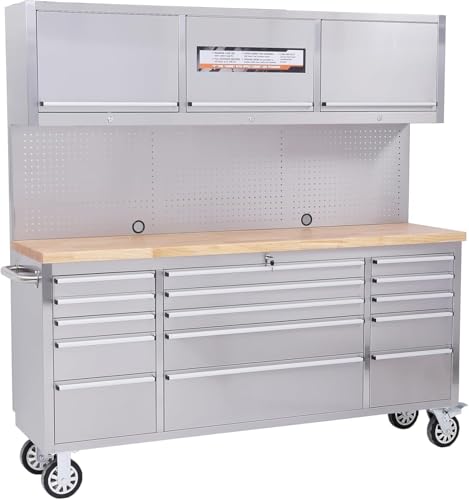 72 in. stainless 15-drawerFifteen drawers under a 72-inch work surface, which is the whole argument for the format: the storage is where the work is rather than across the garage. The cabinet is 430 stainless with an anti-fingerprint finish and the top is solid rubberwood, so the wipe-clean surface here is the carcass rather than the bench top. | A bench that is also a drawer unit | 15drawers under the top | $1,300.00 · Check on Amazon |
| 3 | HuskyNo photo Husky 56 in. 18-drawer comboStill the most completely documented 56-inch combo in the category - 19-gauge body, 120 lb soft-close drawers, 3,000 lb rated, 604 lb empty on six 5 x 2 in casters, all published in one place. The catch as of September 2026 is the route: the Amazon listings have lapsed and it is a Home Depot purchase. | The one-and-done garage upgrade, if you can get to a Home Depot | 19 gabody steel | Check price on Amazon |
| 4 |  GarveeTech 72 in. 15-drawerFifteen lined drawers under a full 72 inches of wood top, with one key lock across the whole bank - the most storage per inch of bench on this page. What the listing will not do is print a number: no top thickness, no per-drawer rating, no total limit. Neither bench compared here publishes a slide rating, and this one is no exception. | Maximum drawers under a work surface | 15drawers, all lined | $987.99 · Check on Amazon |
Every key number is a figure the manufacturer publishes. Where a maker publishes none, the row says so rather than substituting an estimate of ours.
Top pick · Getting the height right rather than living with it
MUWOOD 72 in. Adjustable-Height Workbench with Power Outlet and Pegboard
Six height settings across 28 to 40 inches on a 72 x 24 in solid rubberwood top, with a power strip and a pegboard included. It spans the published elbow-height guidance for essentially any adult, which is the one bench spec that is about you rather than the bench.
- Body steel
- Not published
- Per drawer
- Not published
- Storage
- Not published
- Empty weight
- Not published
What works
- The 28-40 in range covers the elbow-height rule for a short adult through precision work for a tall one
- Six discrete settings rather than two, and no tools to change them
- Power and pegboard included rather than sold as upgrades
- Solid rubberwood rather than a laminate over particle board
What does not
- The published load capacity is not stable - the same maker's near-identical benches carry a figure two and a half times larger, so treat any number here as unverified
- Does not publish a top thickness, which is the number that actually governs deflection
- An adjustable frame is never as rigid as a fixed one under a hand plane
- No vise provision and no dog holes
| Published specification | |
|---|---|
| Top | 72 in x 24 in solid rubberwood |
| Height | Six settings, 28 in to 40 in, no tools needed |
| Power | ETL-certified strip, 4 AC outlets and 2 USB, 9.8 ft cord |
| Pegboard | Included |
| Feet | Adjustable non-slip feet on each leg |
| Top thickness | Not published |
| Load capacity | Listed at 2,000 lb; the same maker lists near-identical 72 in. benches at 5,000 lb, so we publish neither |
| Where it is sold | Amazon, plus other retailers |
Who it is for
One bench used by people of different heights, or for tasks that want different heights.
What it is not for
Hand-tool woodworking, and anyone who needs a capacity figure they can actually rely on.
Sources for this entry
2 · A bench that is also a drawer unit
72 in. Rolling Tool Chest Workbench, 15 Drawers, 430 Stainless
Fifteen drawers under a 72-inch work surface, which is the whole argument for the format: the storage is where the work is rather than across the garage. The cabinet is 430 stainless with an anti-fingerprint finish and the top is solid rubberwood, so the wipe-clean surface here is the carcass rather than the bench top.
- Body steel
- Not published
- Per drawer
- Not published
- Storage
- Not published
- Empty weight
- Not published
What works
- Fifteen drawers directly under the work surface, so tools are within reach of the job
- 72 inches is a genuine bench length rather than a cabinet with a lid
- A 430 stainless carcass wipes clean of oil and solvent, and the finish is specified to resist fingerprints
- Rolls, so it can be pulled away from the wall to work behind
What does not
- Publishes no gauge, no per-drawer rating and no total capacity
- No published top thickness, which is the one figure that governs how a bench behaves under load
- Fifteen drawers at this price means shallow drawers - check the internal depths against your longest tool
- A rolling bench moves under a hand plane; this is an assembly and mechanical bench, not a joinery one
| Published specification | |
|---|---|
| Top | Solid rubberwood; thickness not published |
| Cabinet | 430 stainless, anti-fingerprint finish |
| Width | 72 in |
| Drawers | 15, key lock |
| Casters | Lockable wheels; count not published |
| Body steel | Not published |
| Per-drawer rating | Not published |
| Total capacity | Not published |
| Where it is sold | Amazon, plus other retailers |
Who it is for
A garage where the bench and the tool storage should be the same object.
What it is not for
Hand-tool woodworking, or anyone comparing benches on published numbers.
Sources for this entry
3 · The one-and-done garage upgrade, if you can get to a Home Depot
Husky 56 in. 18-Drawer Professional Tool Chest and Cabinet Set
Still the most completely documented 56-inch combo in the category - 19-gauge body, 120 lb soft-close drawers, 3,000 lb rated, 604 lb empty on six 5 x 2 in casters, all published in one place. The catch as of September 2026 is the route: the Amazon listings have lapsed and it is a Home Depot purchase.
- Body steel
- 19 ga0.0418 in (1.06 mm)
- Per drawer
- 120 lb96 lb working
- Storage
- 24.8 cu ft42,876 cu in
- Empty weight
- 604 lb101 lb per caster, empty
What works
- Publishes a real body gauge, which most listings in this category simply do not
- 120 lb per drawer is genuinely usable: a full 200-piece socket set is around 24 lb
- Six casters rather than four spreads a 600 lb empty weight over more contact points
- Barrel-key locks on both the chest and the cabinet
What does not
- No live Amazon listing right now, so this is a Home Depot trip rather than a delivery you can order from here
- 604 lb empty is a two-person, ramp-and-straps delivery problem
- Husky is a Home Depot house brand, so availability has always come and gone
- 56 in wide plus caster overhang needs about 5 ft of clear wall
| Published specification | |
|---|---|
| Body steel | 19 gauge |
| Drawers | 18 (6-drawer top chest over a 12-drawer cabinet) |
| Per-drawer rating | 120 lb soft-close; deep bottom drawers run dual glides |
| Total capacity | 3,000 lb |
| Empty weight | 604 lb |
| Storage volume | 42,876 cu in |
| Casters | Six, 5 in x 2 in |
| Power | Two power centers, 6 outlets and 2 USB |
| Where to buy | The Home Depot. No live Amazon listing as of September 2026. |
| Where it is sold | The Home Depot |
Who it is for
Someone buying the last box they intend to buy for a decade, with a garage bay to put it in and a Home Depot they can reach.
What it is not for
Anyone who needs it delivered from an online listing today, or who has less than five feet of wall.
No buy button, on purpose
This is sold through The Home Depot rather than Amazon. There is no affiliate link we can build for it, so there is no button here — and no commercial reason for us to push you toward or away from it. How this site is funded.
Sources for this entry
4 · Maximum drawers under a work surface
GarveeTech 72 in. Rolling Tool Chest and Workbench, 15 Drawers
Fifteen lined drawers under a full 72 inches of wood top, with one key lock across the whole bank - the most storage per inch of bench on this page. What the listing will not do is print a number: no top thickness, no per-drawer rating, no total limit. Neither bench compared here publishes a slide rating, and this one is no exception.
- Body steel
- Not published
- Per drawer
- Not published
- Storage
- Not published
- Empty weight
- Not published
What works
- Fifteen drawers under a full 72 in of bench, which is the most storage per inch of bench on this page
- Every drawer is lined, and the liners are in the box rather than sold separately
- One key lock secures the whole bank of fifteen drawers
- A heavy-duty steel carcass under a solid wood top rather than a laminated particle surface
What does not
- Publishes no top thickness, which is the figure that decides how the bench behaves under load
- Publishes no per-drawer rating and no total weight limit, so the storage cannot be planned against a number
- Publishes no body gauge, so the steel around the slides is an unknown
- A rolling bench is never as rigid as a fixed one
| Published specification | |
|---|---|
| Top | Wood top, 72 in; thickness not published |
| Drawers | 15, all lined |
| Per-drawer rating | Not published |
| Total weight limit | Not published |
| Body | Heavy-duty steel |
| Casters | On wheels; count not published |
| Included | Drawer liners and a key lock |
| Body steel gauge | Not published |
| Where it is sold | Amazon, plus other retailers |
Who it is for
Someone who wants the drawers and the work surface to be one object.
What it is not for
Deep assembly work, or hand-tool woodworking that needs a bench that does not move.
Sources for this entry
The height problem, which cuts both ways
A 56-inch rolling cabinet stands about 41 inches tall. Published ergonomic guidance puts a general work surface at roughly elbow height - which for someone 5 ft 10 in is about 43 inches - so a workstation top lands close to right for general work and it is not adjustable.
That is genuinely convenient if you are near average height and a real limitation if you are not, because the cabinet height is set by the drawers inside it. A bench with adjustable legs solves it outright, which is why the bench roundup gives adjustability more credit than its other specs alone would justify. Work out your own number first.
What a workstation genuinely cannot do
Take a vise properly. A bench vise transfers its load into the top and needs a backing plate behind the mounting bolts, which needs the top to overhang the frame. On a workstation there is a cabinet immediately underneath, so there is nowhere for the plate to go and nothing structural to bolt through.
It also moves. A rolling cabinet on locking casters is stable enough for assembly and not stable enough for anything where you apply real force - hammering, planing, breaking a fastener loose with a long bar. If those are the jobs, you want a fixed bench and the workstation is the wrong purchase whatever its storage.
How to decide, quickly
- Do you need a vise? Workstation is out. This is the fastest disqualifier and it is not retrofittable.
- Do you have wall for two units? If yes, a fixed bench plus a separate rolling cabinet beats both - stiffer bench, better-rated drawers.
- If only one unit fits, a workstation is the efficient answer. So is a bench with drawers, which is the same trade approached from the bench side.
- Do you work at the car, or at the bench? A workstation rolls to the car. A bench does not.
- Check the height against your own before either. It is fixed on a workstation.
The two formats converge from opposite directions
A workstation is a cabinet that grew a top. A bench with drawers is a bench that grew storage. They end up looking similar and they differ where it counts: the workstation has better drawer ratings and a worse top, the bench the other way round. Benches with drawers sets out that side of it.
Common questions
What is the difference between a workbench and a workstation?
A workbench is a surface built to be a surface - thick top, stiff frame, somewhere to mount a vise. A workstation is a rolling tool cabinet with a work surface where a top chest would otherwise sit. One is a bench with no storage; the other is storage with a lid.
Can you mount a vise on a mobile workstation?
Usually not. A vise needs a backing plate behind its bolts and a top that overhangs the frame, and on a workstation there is a cabinet immediately underneath. If you need a vise, that rules the format out - and it is not something you can add later.
How tall is a mobile workstation?
It is set by the cabinet, and a 56 in rolling cabinet stands about 41 in. Published guidance puts a general work surface near elbow height, about 43 in for someone 5 ft 10 in, so a workstation is close to right for average height and cannot be adjusted for anyone else.
Is a workstation better than a bench plus a separate cabinet?
Only when space forces it. If you have wall for two units, a fixed bench plus a rolling cabinet gives you a stiffer bench and better-rated drawers for similar money. The workstation wins on footprint, which in a single bay is often the deciding factor.
Sources
Read next
Workbenches with drawers, and what the format costs you
Two purchases in one footprint, with an honest account of the drawer rating you give up and when the trade is worth it.
Tool chest vs workbench: which one first, and why
Which to buy first for a garage, what each does that the other cannot, and the cost of the bench-with-drawers compromise.
Workbench height, worked out from your own body
The elbow-height rule, a table by height and task, a calculator, and the four things that silently change the number.
The best garage workbenches, judged on the top and the height
Benches ranked on published top thickness and rated load, with the height calculation that decides whether any of them suits your body.
Tool chest vs tool cabinet, and which half to buy first
The terminology settled once, and the reason the cabinet is almost always the half to buy first.