Reference
Casters: the component that decides whether the box moves
Load per caster is arithmetic and nobody does it. Wheel diameter decides whether a loaded cabinet crosses an expansion joint or stops dead at it.
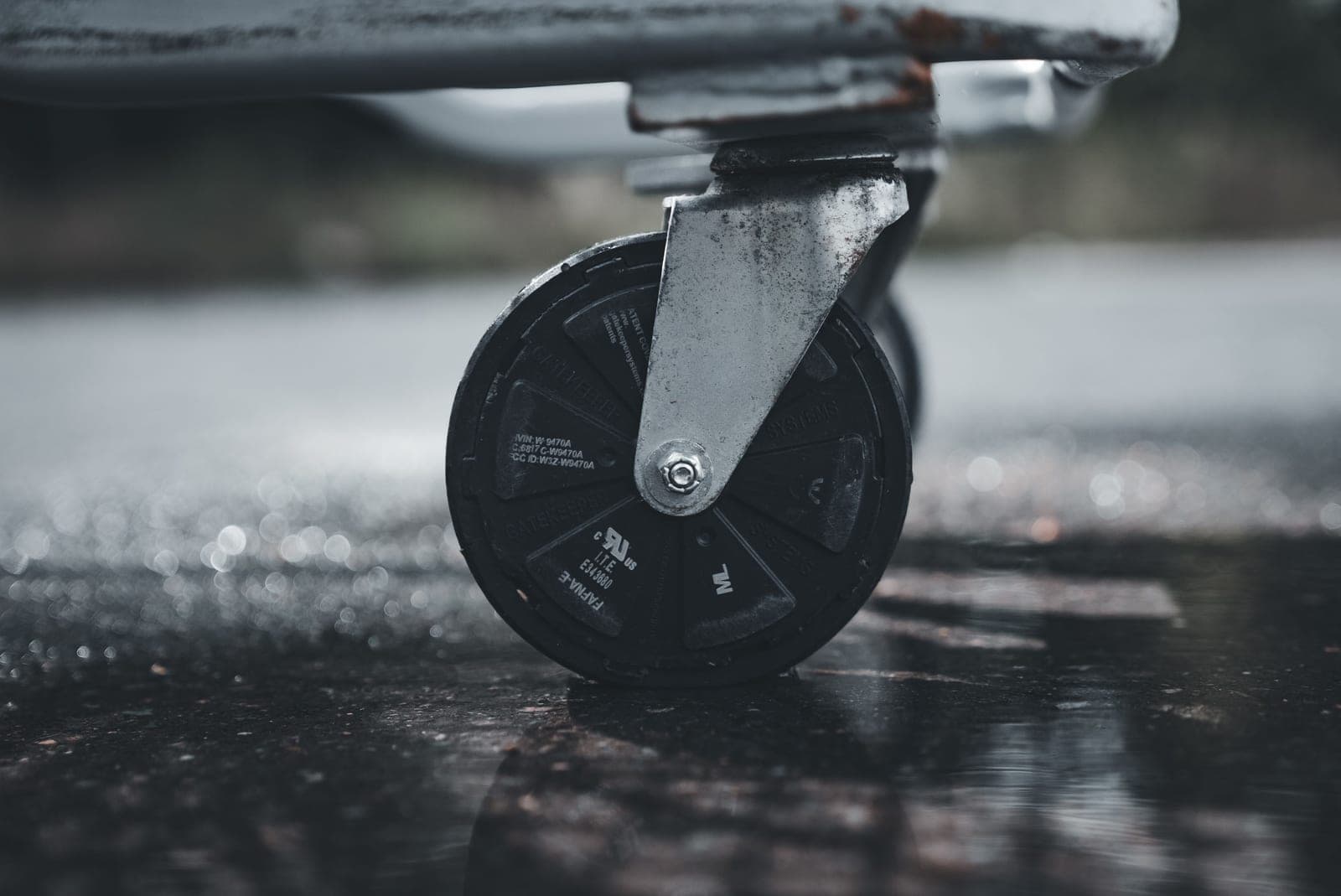
Divide the loaded weight by the number of casters. A 604 lb cabinet loaded to about 900 lb on six casters is 150 lb per wheel; on four it would be 225. Diameter matters separately: a 6-inch wheel crosses a garage expansion joint that stops a 3-inch wheel dead.
Load per caster, and why six beats four
This is the arithmetic nobody does. Caster ratings are published per caster, and the load on each one is the total weight divided by the number of wheels - assuming the floor is flat and the load is even, neither of which is quite true.
One published 56-inch combo set is 604 lb empty on six 5 x 2 in casters. Loaded to a realistic 900 lb, that is 150 lb per wheel. The same box on four casters would be 225 lb per wheel - a 50 percent increase in load on each one, which shows up as more rolling resistance, more flex in the base rail, and faster bearing wear.
Work out your own drawer
What is going in one drawer
- Mechanic's socket set, 200 pc24 lb0
- Combination wrench set, 22 pc11 lb0
- Impact socket set, 1/2 in drive18 lb0
- Screwdriver set, 20 pc6 lb0
- Pliers and cutters, 8 pc9 lb0
- Cordless drill plus two batteries8 lb0
- 1/2 in torque wrench6 lb0
- Hammers and pry bars14 lb0
0 lb
In that one drawer
96 lb
Working load at 80% of 120 lb
604 lb
Loaded box, 101 lb per caster
Add something above and the arithmetic runs.
It also matters for uneven floors. On a floor that is not perfectly flat, a four-caster box rocks between three contact points at a time, so the momentary load on one wheel can be well above the average. Six casters spread it and the box sits more solidly.
Diameter is about obstacles, not weight
A bigger wheel rolls over a step of a given height more easily than a small one, for straightforward geometric reasons: the larger the wheel radius relative to the obstacle, the shallower the effective angle it has to climb. Practically, in a garage, that means expansion joints and drain channels.
| Wheel diameter | Where you see it | What it handles |
|---|---|---|
| 2-3 in | Light cabinets and workbenches | A smooth flat floor and nothing else |
| 5 in | Mainstream tool cabinets | Most garage floors; struggles at a wide expansion joint |
| 6 in | Better cabinets and heavy benches | Expansion joints, drain channels, small thresholds |
| 8-9 in | Modular rolling bases | Gravel, curbs and job-site ground |
Published examples: one 56 in cabinet uses six 5 x 2 in casters; another uses four 6 x 2 in. Modular rolling bases publish 8 in (ToughSystem 2.0) and 9 in (PACKOUT) all-terrain wheels because they are designed to leave the shop floor.
Width matters too, and for a different reason
A 5 x 2 in caster is 5 inches in diameter and 2 inches wide. Width spreads the load across the floor, which matters on soft surfaces - asphalt in summer, an old garage floor with a soft screed, or anything with a coating. A narrow wheel under 200 lb marks a coated floor; a wide one is far less likely to.
It is also why you should not leave a heavy loaded box parked on the same spot on an epoxy-coated floor for years. The load does not go away because nothing is moving.
Locks: what actually locks
- Wheel brake stops the wheel rotating. The caster can still swivel, so the box can still shuffle sideways.
- Swivel lock stops the caster turning. The box can still roll.
- Total lock does both, and it is what a loaded cabinet actually needs.
- Toe lock is a total lock you can operate with a boot - worth a lot when both hands have tools in them.
- Fixed casters do not swivel at all. Two fixed at the back and two swiveling at the front is a common and good arrangement: the box tracks straight instead of crabbing.
Moving a loaded box safely
- Close and lock every drawer first. A drawer that rolls open mid-move shifts several hundred pounds of load and is how boxes tip.
- Push, do not pull. Pushing puts your weight behind the box; pulling puts the box's momentum behind you.
- Cross joints square on. A wheel hitting an expansion joint at an angle catches one caster and turns the box.
- Never move it on a slope with the drawers loaded high. Weight up high plus a slope is exactly the tipping case. Heaviest things in the bottom drawers.
- If it will not roll, do not force it. A caster that has flat-spotted from years parked in one place needs replacing, not shoving. The same caster logic decides whether a tool cart rolls over your floor - there, diameter is usually the published figure that matters most.
Replacing a caster
It is a straightforward job and the main trap is the mounting pattern: cabinet casters are usually plate-mounted with a four-bolt pattern that varies by maker. Measure the plate and the bolt spacing before ordering, and match or exceed the original load rating.
Also match the height. A replacement caster half an inch taller than the others puts the cabinet out of level and loads the other wheels unevenly, and on a bench it changes the working height. Bench height. If you are still choosing, rolling tool boxes separates the job-site cases from the shop cabinets.
Common questions
How much weight can tool box casters hold?
The published rating is per caster, so divide your loaded weight by the number of wheels. A 604 lb cabinet loaded to 900 lb sits at 150 lb per wheel on six casters, or 225 lb on four. Nobody publishes the loaded weight because it depends on your tools.
Are 6-inch casters better than 5-inch on a tool box?
For obstacles, yes. A larger wheel climbs a step of a given height at a shallower effective angle, which in a garage means crossing expansion joints and drain channels. For load, width matters more than diameter.
Why do some tool chests have six casters?
To reduce load per wheel and to sit more solidly on an uneven floor. A 900 lb loaded box is 150 lb per wheel on six casters and 225 lb on four, and on an uneven floor a four-caster box rocks between three contact points at a time.
How do I move a loaded tool chest safely?
Lock every drawer first, push rather than pull, cross expansion joints square on, and never move it on a slope with weight in the high drawers. A drawer rolling open mid-move shifts hundreds of pounds and is how boxes tip.
Sources
Read next
The best tool carts, and the rating almost none of them split by shelf
Four service carts compared on published capacity, per-shelf ratings, caster size and tray depth - and the one that publishes its steel gauge.
Rolling tool boxes, and the two very different things that phrase means
Job-site cases and shop cabinets are both sold as rolling tool boxes. The specs that decide them are completely different, and here is each.
What your drawer actually weighs, and what the box weighs full
The calculator for your own heaviest drawer, published tool weights, and the loaded-box figure no manufacturer prints.
How tool boxes are measured, and what the number leaves out
What the width figure includes and excludes, the cubic-inch conversion, and the measurements the listing will never give you.
56-inch tool chests, and the five feet of wall they really need
What a 56-inch cabinet really needs in floor space, what the width figure excludes, and the ones worth buying on published specs.
Rolling workbenches, and the two things wheels cost you
When wheels are worth it, the height they silently add, and the difference between a wheel lock and a total lock.
How to organize a tool chest, in the order that works
Frequency decides the height, weight decides the depth, and the buying order that puts foam last for a reason.