Head to head
PACKOUT vs ToughSystem 2.0: identical headline specs, one real difference
Both publish 250 lb and IP65. The decision comes down to what you already own and how big a range you want to grow into.
Both publish 250 lb for the rolling base and both are IP65. PACKOUT has 9-inch wheels and the larger accessory range; ToughSystem 2.0 has 8-inch wheels and is backward compatible with every earlier ToughSystem product. If you own older DeWalt boxes, that compatibility decides it. If you own nothing, range size does.
Where you can actually buy each one
| Brand | Where it is sold | Do we earn anything? |
|---|---|---|
| Milwaukee PACKOUT | Home Depot, Amazon and tool dealers | Yes, on the Amazon listings |
| DeWalt ToughSystem 2.0 | Amazon, Lowe's, Ace and tool dealers | Yes, on the Amazon listings |
We say this on every comparison because it changes what our recommendation is worth to you. Where we earn nothing, there is no commercial reason for us to steer you anywhere.
The published figures, side by side
| Milwaukee PACKOUT | DeWalt ToughSystem 2.0 | |
|---|---|---|
| Rolling base capacity | 250 lb dynamic / 1,000 lb static | 250 lb |
| Weather rating | IP65 | IP65 |
| Wheels | 9 in all-terrain | 8 in |
| Handle | 19.75 in fully collapsible | 26-5/8 in stowed, 38-7/8 in extended |
| Base weight | Not published | 20.61 lb |
| Base dimensions | Not published in the same form | 23-7/8 in W x 19-5/8 in L x 16-5/8 in H |
| Connection | Integrated locking cleats | Patented auto-connect side latches, one-handed |
| Backward compatible | No predecessor system | Yes, with any earlier ToughSystem product |
| Accessory range | The largest in the category | Smaller, but substantial |
All figures as published by the manufacturers. Milwaukee is the only one to publish separate dynamic and static capacities, which is transparency rather than an advantage - compare 250 against 250.
The dynamic-versus-static trap
Milwaukee publishes 250 lb dynamic and 1,000 lb static. It is tempting to read the 1,000 as PACKOUT's capacity and conclude it is four times stronger than ToughSystem. It is not. Static is what the box holds standing still; dynamic is what it carries while rolling, which loads the wheels, the axle and the handle instead of just the box structure.
DeWalt publishes one number, and that number is almost certainly the dynamic one. So the honest comparison is 250 against 250, and on capacity these two systems are level.
Quick picks
Ranked on published specifications, not on hype. The key number is the figure that decides each pick, quoted from the maker. Tap a row for the full write-up, or go straight to the listing.
| # | Product | Best for | Key number | Price |
|---|---|---|---|---|
| 1 | 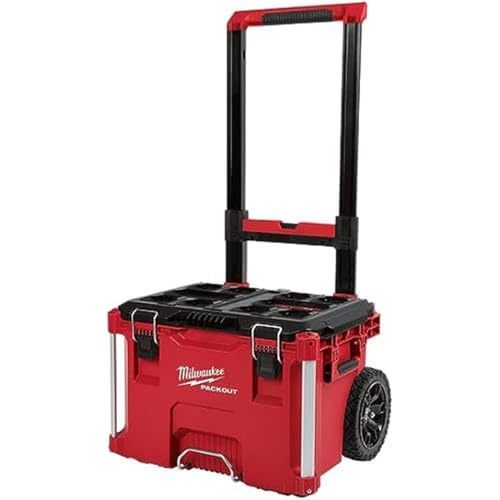 PACKOUT rolling tool boxMilwaukee publishes two capacities and both are worth knowing: 250 lb while you are rolling it, 1,000 lb standing still. Every other PACKOUT component clips to it, which is the actual product being sold. | The base of the largest modular ecosystem | 250 lbdynamic capacity | $189.00 · Check on Amazon |
| 2 | DeWaltNo photo ToughSystem 2.0 rolling boxMatches PACKOUT's 250 lb and IP65 with one advantage Milwaukee cannot offer: it is backward compatible with every earlier ToughSystem box, so an existing collection is not stranded. | The PACKOUT alternative that is backward compatible | 250 lbload capacity | Check price on Amazon |
Every key number is a figure the manufacturer publishes. Where a maker publishes none, the row says so rather than substituting an estimate of ours.
Top pick · The base of the largest modular ecosystem
Milwaukee PACKOUT Rolling Tool Box (48-22-8426)
Milwaukee publishes two capacities and both are worth knowing: 250 lb while you are rolling it, 1,000 lb standing still. Every other PACKOUT component clips to it, which is the actual product being sold.
- Body steel
- Not published
- Per drawer
- Not published
- Storage
- Not published
- Empty weight
- Not published
What works
- Publishes a dynamic AND a static capacity, which almost nobody in modular storage does
- 9 in wheels handle a gravel driveway and a curb, not just a shop floor
- The largest component range of any modular system, so the base has somewhere to grow
- IP65 means rain on a truck bed is not a problem
What does not
- 250 lb dynamic is the real ceiling and a loaded stack passes it easily
- You are buying into an ecosystem: leaving it later means replacing the whole stack
- Sold through many channels, so the Amazon listing is not always the best price
| Published specification | |
|---|---|
| Dynamic capacity | 250 lb (in motion) |
| Static capacity | 1,000 lb (stationary) |
| Wheels | 9 in all-terrain |
| Handle | 19.75 in fully collapsible |
| Weather | IP65-rated seal |
| Connection | Integrated locking cleats, compatible with all PACKOUT components |
| Where it is sold | Amazon, plus other retailers |
Who it is for
Anyone whose tools travel - job site, driveway, or a second garage.
What it is not for
A fixed garage bay, where a steel cabinet gives far more storage per dollar.
Sources for this entry
2 · The PACKOUT alternative that is backward compatible
DeWalt ToughSystem 2.0 Rolling Toolbox (DWST08450)
Matches PACKOUT's 250 lb and IP65 with one advantage Milwaukee cannot offer: it is backward compatible with every earlier ToughSystem box, so an existing collection is not stranded.
- Body steel
- Not published
- Per drawer
- Not published
- Storage
- Not published
- Empty weight
- 20.61 lb10 lb per caster, empty
What works
- Backward compatible with the older ToughSystem line, which PACKOUT is not
- Auto-connect side latches work one-handed
- Two-piece metal front latches rather than all-plastic
- 20.61 lb empty is light for the size
What does not
- 8 in wheels rather than PACKOUT's 9 in over rough ground
- Smaller accessory range than PACKOUT
- 250 lb is the whole stack, not per box
| Published specification | |
|---|---|
| Load capacity | 250 lb |
| Weather | IP65 dust and water resistant |
| Wheels | 8 in |
| Dimensions | 23-7/8 in W x 19-5/8 in L x 16-5/8 in H to lid |
| Handle | 26-5/8 in stowed, 38-7/8 in extended |
| Weight | 20.61 lb |
| Compatibility | Backward compatible with earlier ToughSystem products |
| Where it is sold | Amazon, plus other retailers |
Who it is for
Anyone already holding ToughSystem boxes, and anyone who wants IP65 on a budget.
What it is not for
A buyer starting fresh who wants the widest possible accessory range.
Sources for this entry
The one real difference: what you already own
DeWalt publishes that ToughSystem 2.0 is backward compatible with any ToughSystem product. If you have a shelf of first-generation boxes, that means the upgrade is incremental rather than a replacement, and nothing you own becomes scrap.
PACKOUT cannot offer this, because there was no earlier Milwaukee system to be compatible with. That is not a criticism - it is simply the one axis on which ToughSystem wins outright, and for an existing DeWalt owner it usually settles the whole question.
If you own neither: range size is the tiebreaker
Modular storage has an unusual property - the value of the first purchase depends on how many second purchases exist. A base with three compatible modules is a box; a base with dozens is a system you can shape around your work over years.
PACKOUT's range is the largest in the category by a clear margin, and there is a wider third-party ecosystem of mounts, racks and truck-bed fittings built around it. For a buyer starting fresh, that is the strongest single argument either system has.
The wheels, which matter more than the inch suggests
Nine inches against eight sounds like a rounding difference and is not. A larger wheel climbs an obstacle of a given height at a shallower effective angle, so the gap shows up exactly where it matters: a curb, a gravel driveway, a rough site.
On a smooth shop floor it makes no difference at all. If your stack never leaves flat concrete, ignore this row entirely. The casters page has the geometry.
The question neither system answers
Whether you should be buying a modular system at all. Against a steel rolling cabinet, both of these store far less per dollar and hold far less weight - one 56-inch cabinet drawer can be rated at 120 lb per pair, eighteen times over, against 250 lb for an entire rolling stack.
Modular buys portability and weather sealing, which are worth a great deal if the tools leave the garage and close to nothing if they do not. Tool chest vs PACKOUT is that decision, properly.
Common questions
Is PACKOUT or ToughSystem 2.0 better?
On published capacity and weather rating they are level: both 250 lb for the rolling base and both IP65. PACKOUT has 9 in wheels and a larger range; ToughSystem 2.0 has 8 in wheels and is backward compatible with earlier ToughSystem boxes.
Does PACKOUT really hold 1,000 lb?
Standing still, yes - that is the static figure Milwaukee publishes. While rolling it is 250 lb, which is the figure that binds in practice and the one to compare against other brands, since everyone else publishes a single number that is almost certainly dynamic.
Can PACKOUT and ToughSystem boxes be mixed?
No. Cleat and latch geometry is proprietary to each family and no adapter makes cross-mixing a good idea. Mixing means owning two stacks that do not attach to each other, which is worse than owning one of either.
Sources
Read next
PACKOUT vs Klein MODbox: same base rating, opposite priorities
Same published 250 lb base, opposite priorities: drawers at the bottom of the stack against the biggest range in the category and a published IP65.
PACKOUT vs StackTech: the same base rating, two different bets
Same published base rating, opposite bets: drawers in every module against IP65 and the biggest accessory range in the category.
Milwaukee PACKOUT, explained by its own specification sheet
How PACKOUT works, what its two published capacities mean, what IP65 covers, and which piece to buy first.
DeWalt ToughSystem 2.0, and the one thing PACKOUT cannot do
The published numbers, the tower, and the backward compatibility that is the one axis where it beats PACKOUT outright.
Tool chest vs PACKOUT: two answers to two different questions
Storage per dollar against portability, with the numbers laid out and one question that decides which you should buy.
Best modular tool storage systems, on the numbers they publish
Five systems compared on published dynamic capacity, weather rating and range size, with the 50 lb versus 250 lb gap that decides it.
How to pick a stacking system you will not regret
Three questions in order, the weight table that decides which systems are even eligible, and the switching cost nobody puts in a comparison.