The flagship roundup
The best garage workbenches, judged on the top and the height
Two specs decide a bench: how thick the top is, and whether it sits at the right height for your body. Almost no listing publishes the first and none of them knows the second.

For most garages the adjustable-height steel bench is the pick, because height is the one bench dimension that is genuinely personal and a fixed 34-inch top is wrong for most adults by two to four inches. If you want drawers in the same footprint, a 1.5 in solid-wood top over rated drawers is the better trade.
Why height comes before every other spec
Published ergonomic guidance for a general work surface is elbow height, with precision assembly a couple of inches above it and heavy work - planing, hammering, anything where you want body weight over the work - well below. That produces a published range of roughly 34 to 38 inches for general bench work, and the range is not vagueness. It is the acknowledgement that people are different sizes.
Elbow height is roughly 62.5 percent of standing height, so a person 5 ft 4 in and a person 6 ft 2 in have elbows about seven inches apart. No single catalog number is right for both. That is the entire argument for adjustable legs, and it is why an adjustable bench earns more credit here than its other specs alone would justify.
| Your height | Elbow height | Precision and assembly | General bench work | Heavy work, planing, hammering |
|---|---|---|---|---|
| 5 ft 4 in | 40 in | 43 in | 39 in | 33 in |
| 5 ft 6 in | 41.3 in | 44 in | 40 in | 34 in |
| 5 ft 8 in | 42.5 in | 46 in | 42 in | 36 in |
| 5 ft 10 in | 43.8 in | 47 in | 43 in | 37 in |
| 6 ft 0 in | 45 in | 48 in | 44 in | 38 in |
| 6 ft 2 in | 46.3 in | 49 in | 45 in | 39 in |
| 6 ft 4 in | 47.5 in | 51 in | 47 in | 41 in |
Elbow height is estimated at 62.5 percent of standing height. That coefficient is the one estimate on this page and it is an average, not your body — measure your own elbow if you can, and use the row as a starting point if you cannot.
Quick picks
Ranked on published specifications, not on hype. The key number is the figure that decides each pick, quoted from the maker. Tap a row for the full write-up, or go straight to the listing.
| # | Product | Best for | Key number | Price |
|---|---|---|---|---|
| 1 |  MUWOOD 72 in. adjustableSix height settings across 28 to 40 inches on a 72 x 24 in solid rubberwood top, with a power strip and a pegboard included. It spans the published elbow-height guidance for essentially any adult, which is the one bench spec that is about you rather than the bench. | Getting the height right rather than living with it | 28-40 inadjustable height | $265.99 · Check on Amazon-9% |
| 2 | 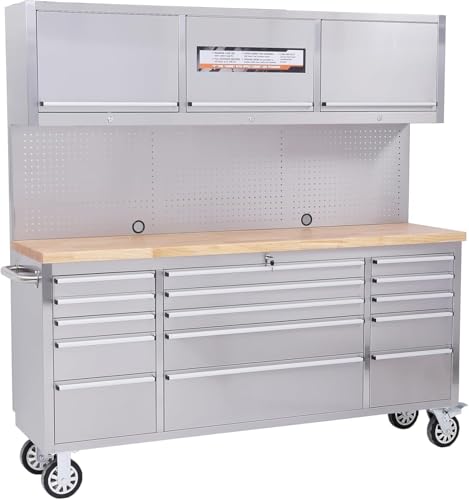 72 in. stainless 15-drawerFifteen drawers under a 72-inch work surface, which is the whole argument for the format: the storage is where the work is rather than across the garage. The cabinet is 430 stainless with an anti-fingerprint finish and the top is solid rubberwood, so the wipe-clean surface here is the carcass rather than the bench top. | A bench that is also a drawer unit | 15drawers under the top | $1,300.00 · Check on Amazon |
| 3 |  GarveeTech 72 in. 15-drawerFifteen lined drawers under a full 72 inches of wood top, with one key lock across the whole bank - the most storage per inch of bench on this page. What the listing will not do is print a number: no top thickness, no per-drawer rating, no total limit. Neither bench compared here publishes a slide rating, and this one is no exception. | Maximum drawers under a work surface | 15drawers, all lined | $987.99 · Check on Amazon |
| 4 |  Seville UltraHD 77 in. benchA steel-framed rolling cabinet with a solid wood top and eleven drawers, at 77 inches wide - the widest bench on this site. It is a bench and a drawer bank in one footprint, and at 37.5 inches tall it is higher than most adults' general-bench number. | Bench and drawer bank in one 77-inch unit | 77 inwidth | $894.48 · Check on Amazon |
Every key number is a figure the manufacturer publishes. Where a maker publishes none, the row says so rather than substituting an estimate of ours.
Top pick · Getting the height right rather than living with it
MUWOOD 72 in. Adjustable-Height Workbench with Power Outlet and Pegboard
Six height settings across 28 to 40 inches on a 72 x 24 in solid rubberwood top, with a power strip and a pegboard included. It spans the published elbow-height guidance for essentially any adult, which is the one bench spec that is about you rather than the bench.
- Body steel
- Not published
- Per drawer
- Not published
- Storage
- Not published
- Empty weight
- Not published
What works
- The 28-40 in range covers the elbow-height rule for a short adult through precision work for a tall one
- Six discrete settings rather than two, and no tools to change them
- Power and pegboard included rather than sold as upgrades
- Solid rubberwood rather than a laminate over particle board
What does not
- The published load capacity is not stable - the same maker's near-identical benches carry a figure two and a half times larger, so treat any number here as unverified
- Does not publish a top thickness, which is the number that actually governs deflection
- An adjustable frame is never as rigid as a fixed one under a hand plane
- No vise provision and no dog holes
| Published specification | |
|---|---|
| Top | 72 in x 24 in solid rubberwood |
| Height | Six settings, 28 in to 40 in, no tools needed |
| Power | ETL-certified strip, 4 AC outlets and 2 USB, 9.8 ft cord |
| Pegboard | Included |
| Feet | Adjustable non-slip feet on each leg |
| Top thickness | Not published |
| Load capacity | Listed at 2,000 lb; the same maker lists near-identical 72 in. benches at 5,000 lb, so we publish neither |
| Where it is sold | Amazon, plus other retailers |
Who it is for
One bench used by people of different heights, or for tasks that want different heights.
What it is not for
Hand-tool woodworking, and anyone who needs a capacity figure they can actually rely on.
Sources for this entry
2 · A bench that is also a drawer unit
72 in. Rolling Tool Chest Workbench, 15 Drawers, 430 Stainless
Fifteen drawers under a 72-inch work surface, which is the whole argument for the format: the storage is where the work is rather than across the garage. The cabinet is 430 stainless with an anti-fingerprint finish and the top is solid rubberwood, so the wipe-clean surface here is the carcass rather than the bench top.
- Body steel
- Not published
- Per drawer
- Not published
- Storage
- Not published
- Empty weight
- Not published
What works
- Fifteen drawers directly under the work surface, so tools are within reach of the job
- 72 inches is a genuine bench length rather than a cabinet with a lid
- A 430 stainless carcass wipes clean of oil and solvent, and the finish is specified to resist fingerprints
- Rolls, so it can be pulled away from the wall to work behind
What does not
- Publishes no gauge, no per-drawer rating and no total capacity
- No published top thickness, which is the one figure that governs how a bench behaves under load
- Fifteen drawers at this price means shallow drawers - check the internal depths against your longest tool
- A rolling bench moves under a hand plane; this is an assembly and mechanical bench, not a joinery one
| Published specification | |
|---|---|
| Top | Solid rubberwood; thickness not published |
| Cabinet | 430 stainless, anti-fingerprint finish |
| Width | 72 in |
| Drawers | 15, key lock |
| Casters | Lockable wheels; count not published |
| Body steel | Not published |
| Per-drawer rating | Not published |
| Total capacity | Not published |
| Where it is sold | Amazon, plus other retailers |
Who it is for
A garage where the bench and the tool storage should be the same object.
What it is not for
Hand-tool woodworking, or anyone comparing benches on published numbers.
Sources for this entry
3 · Maximum drawers under a work surface
GarveeTech 72 in. Rolling Tool Chest and Workbench, 15 Drawers
Fifteen lined drawers under a full 72 inches of wood top, with one key lock across the whole bank - the most storage per inch of bench on this page. What the listing will not do is print a number: no top thickness, no per-drawer rating, no total limit. Neither bench compared here publishes a slide rating, and this one is no exception.
- Body steel
- Not published
- Per drawer
- Not published
- Storage
- Not published
- Empty weight
- Not published
What works
- Fifteen drawers under a full 72 in of bench, which is the most storage per inch of bench on this page
- Every drawer is lined, and the liners are in the box rather than sold separately
- One key lock secures the whole bank of fifteen drawers
- A heavy-duty steel carcass under a solid wood top rather than a laminated particle surface
What does not
- Publishes no top thickness, which is the figure that decides how the bench behaves under load
- Publishes no per-drawer rating and no total weight limit, so the storage cannot be planned against a number
- Publishes no body gauge, so the steel around the slides is an unknown
- A rolling bench is never as rigid as a fixed one
| Published specification | |
|---|---|
| Top | Wood top, 72 in; thickness not published |
| Drawers | 15, all lined |
| Per-drawer rating | Not published |
| Total weight limit | Not published |
| Body | Heavy-duty steel |
| Casters | On wheels; count not published |
| Included | Drawer liners and a key lock |
| Body steel gauge | Not published |
| Where it is sold | Amazon, plus other retailers |
Who it is for
Someone who wants the drawers and the work surface to be one object.
What it is not for
Deep assembly work, or hand-tool woodworking that needs a bench that does not move.
Sources for this entry
4 · Bench and drawer bank in one 77-inch unit
Seville Classics UltraHD Rolling Workbench, 77 in., 11-Drawer
A steel-framed rolling cabinet with a solid wood top and eleven drawers, at 77 inches wide - the widest bench on this site. It is a bench and a drawer bank in one footprint, and at 37.5 inches tall it is higher than most adults' general-bench number.
- Body steel
- Not published
- Per drawer
- Not published
- Storage
- Not published
- Empty weight
- Not published
What works
- 77 inches is the widest work surface on this site, and width is the cheap dimension on a bench
- Eleven drawers makes this a bench and a cabinet in one footprint
- Solid wood top rather than the laminated board most benches at this price use
- Part of the UltraHD range, so matching cabinets and shelving exist
What does not
- 37.5 in tall is above the published elbow-height figure for most adults, and it does not adjust
- Neither a per-drawer rating nor a total capacity is published, so the drawer arithmetic cannot be done
- No published top thickness - the spec that predicts flex under a vise
- 77 in of rolling bench needs a genuinely flat floor and a long wall
| Published specification | |
|---|---|
| Dimensions | 77 in W x 20 in D x 37.5 in H |
| Top | Solid wood |
| Frame | Steel, rolling cabinet |
| Drawers | 11 |
| Finish | Graphite |
| Per-drawer rating | Not published |
| Total capacity | Not published |
| Where it is sold | Amazon, plus other retailers |
Who it is for
A long wall, and someone who wants the bench and the drawers in one purchase.
What it is not for
A short garage, or anyone who needs a published drawer rating before loading it. Check the height against your own elbow first.
Sources for this entry
How we picked
- Published top thickness first. It is the spec that predicts flex under a vise, and the one most listings omit. Benches that publish it rank above benches that do not.
- Rated capacity second, because a bench frame that is rated tells you the maker thought about it.
- Height, adjustable or fixed. Adjustability is not a gimmick in this category - it is the fix for the fact that one catalog height cannot suit every body.
- Drawers, where present, judged on published slide rating per pair like any other drawer on this site.
What we did not do
Everyone in this category says they spent seventy-five hours testing tool chests. We have not opened any of these boxes, and we say so. What we do instead: compile the published specs, convert the steel gauges, multiply out the slide ratings, cite the maker’s own listing, and show the arithmetic so you can check it. The full method, including how to challenge a figure.
What we would skip
A list with no losers is a list nobody edited. These are the choices we would actively steer you away from, and why.
A particleboard top with a laminate on it
It photographs like wood, it is flat out of the box, and it does two things badly: it swells irreversibly if it gets wet, and edge-mounting a vise pulls the fixings straight out of it. If the listing does not say solid wood or steel, assume it is not.
A rolling bench for a bench that never needs to move
Casters cost you two to three inches of height you may not want, and no bench on wheels is as stiff as one bolted to a wall. Buy rolling only if the bench genuinely has to move or you need to get behind it.
Buying before you know your own bench height
The published guidance runs from 34 to 38 inches for general work, and that range exists because the rule is relative to your elbow, not to a catalog. Work out your own number first - it takes about thirty seconds and it eliminates benches.
The top: thickness is the spec, material is the preference
A bench top has one job - not moving. Thickness is what resists flex when you clamp to the edge or lean into a vise, and it is the spec most listings leave out entirely. Where a maker publishes it, take it seriously: 1.5 inches of solid rubberwood behaves completely differently from a 0.75 inch laminated panel, even when both look identical in a photograph.
Material is more a matter of what you do. Wood is quieter, kinder to work laid on it, and takes a vise bolt properly. Steel wipes clean, does not care about solvents, and you can weld near it. The full materials page has the trade-offs and what each surface does to a vise mount.
Drawers under the bench: the honest trade
A bench with drawers is two purchases in one footprint, which in a single-car garage is often decisive. The catch is that bench drawers publish lower ratings than cabinet drawers - 100 lb per pair is typical against the 120 to 150 lb the better rolling cabinets manage - because the frame is carrying a work surface as well as the load.
Apply the published 70-80 percent design guidance and a 100 lb bench drawer is an 80 lb drawer, which is one socket set plus a wrench set. That is fine for hand tools and not enough for a serious deep drawer. If you have the space, a plain bench beside a rolling cabinet beats a bench with drawers on both counts. The comparison sets out both sides.
One caveat on all of this: if the work is woodworking rather than general garage use, the specification changes completely. Woodworking benches are judged on top thickness, vises and dog holes instead. If the budget is the binding constraint instead, best workbenches under $300 covers what the price cuts first.
What to check before you order
- Your bench height, from the calculator, against the bench's published height. Casters add two to three inches to it.
- Published top thickness. If it is absent, assume thin.
- Whether the frame is rated, and to what. A published number means somebody calculated it.
- Assembly. A 72-inch bench is an awkward solo job; plan for a second person.
- Vise mounting. If you intend to fit a vise, check the top overhangs the frame enough to get a backing plate behind it.
Common questions
What is the best workbench for a garage?
For most garages, an adjustable-height steel bench - because height is the one bench spec that is personal and a fixed 34-inch top is wrong for most adults. If you need drawers in the same footprint, look for a 1.5 in solid-wood top over drawers with a published slide rating.
How thick should a garage workbench top be?
1.4 to 1.5 inches of solid wood is the practical floor for a general bench, and thicker is stiffer. Thickness is what resists flex when you clamp to the edge or lean on a vise. Laminated particleboard photographs the same and behaves very differently. Workbench tops.
How much weight can a garage workbench hold?
Published frame ratings on consumer benches run from about 1,000 lb to 2,000 lb. Drawer ratings are separate and much lower - typically 100 lb per pair, which is 80 lb after the published 70-80 percent design guidance. Drawer slides.
Sources
Read next
Best workbenches under $300, and the one number the price cuts first
Four benches under $300 compared on published thickness, height and capacity - and why the capacity claims are the least useful number on the page.
How to choose a workbench, in the order that matters
Height first because it is the only spec about you, then top thickness, depth, and whether drawers belong in the same purchase.
Workbench height, worked out from your own body
The elbow-height rule, a table by height and task, a calculator, and the four things that silently change the number.
Workbench tops: thickness first, then material
Why thickness beats material, the five surfaces compared, and the vise-mounting check that is not retrofittable.
Workbenches with drawers, and what the format costs you
Two purchases in one footprint, with an honest account of the drawer rating you give up and when the trade is worth it.
Tool chest vs workbench: which one first, and why
Which to buy first for a garage, what each does that the other cannot, and the cost of the bench-with-drawers compromise.