Tight spaces
Fitting a real workbench into a garage with a car in it
The constraint is not the bench, it is the door swing and the walkway. Get those two right and a surprising amount of bench fits.

In a single-car bay the binding constraints are car door swing and a walkway of about 30 inches. A 24-inch-deep bench along the long wall usually works; a 30-inch-deep one usually does not. Length is cheap - go long and shallow rather than short and deep.
There is a third route worth weighing before either: a bench that folds flat and stores behind a door. Folding and portable benches compares them on published capacity and folded depth.
Measure the three things that actually decide it
- Car door swing. Park where you actually park, open the door fully, and measure from the wall to the door edge. That number is your maximum bench depth on that wall, minus a hand's width.
- Walkway. You need about 30 inches to walk past comfortably with something in your hands. Less than 24 and you will turn sideways every time, which gets old.
- The long wall. Length is the cheap dimension. A 72-inch bench at 24 inches deep takes less usable floor than a 48-inch bench at 30 inches deep, and gives you far more work surface.
Go long and shallow
This is the whole trick, and it is counterintuitive because depth feels like the thing that makes a bench substantial. It is not. At 24 inches you can reach the back of the bench; at 30 you cannot, and the back becomes storage you have to lean over. Meanwhile every extra inch of depth comes directly off the walkway.
So the small-garage bench is 24 inches deep and as long as the wall allows. That gives you a work zone in the middle and set-down space either side, which is what actually makes a bench pleasant.
Quick picks
Ranked on published specifications, not on hype. The key number is the figure that decides each pick, quoted from the maker. Tap a row for the full write-up, or go straight to the listing.
| # | Product | Best for | Key number | Price |
|---|---|---|---|---|
| 1 |  MUWOOD 72 in. adjustableSix height settings across 28 to 40 inches on a 72 x 24 in solid rubberwood top, with a power strip and a pegboard included. It spans the published elbow-height guidance for essentially any adult, which is the one bench spec that is about you rather than the bench. | Getting the height right rather than living with it | 28-40 inadjustable height | $265.99 · Check on Amazon-9% |
| 2 | 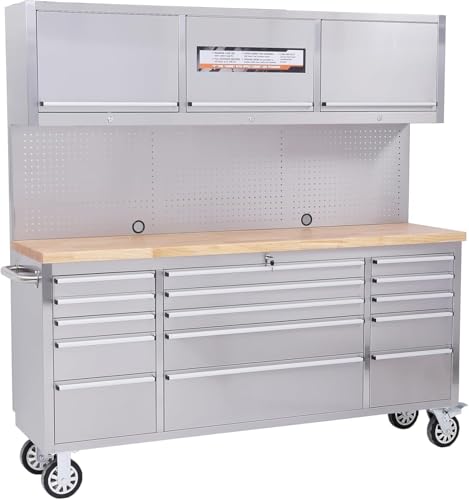 72 in. stainless 15-drawerFifteen drawers under a 72-inch work surface, which is the whole argument for the format: the storage is where the work is rather than across the garage. The cabinet is 430 stainless with an anti-fingerprint finish and the top is solid rubberwood, so the wipe-clean surface here is the carcass rather than the bench top. | A bench that is also a drawer unit | 15drawers under the top | $1,300.00 · Check on Amazon |
Every key number is a figure the manufacturer publishes. Where a maker publishes none, the row says so rather than substituting an estimate of ours.
Top pick · Getting the height right rather than living with it
MUWOOD 72 in. Adjustable-Height Workbench with Power Outlet and Pegboard
Six height settings across 28 to 40 inches on a 72 x 24 in solid rubberwood top, with a power strip and a pegboard included. It spans the published elbow-height guidance for essentially any adult, which is the one bench spec that is about you rather than the bench.
- Body steel
- Not published
- Per drawer
- Not published
- Storage
- Not published
- Empty weight
- Not published
What works
- The 28-40 in range covers the elbow-height rule for a short adult through precision work for a tall one
- Six discrete settings rather than two, and no tools to change them
- Power and pegboard included rather than sold as upgrades
- Solid rubberwood rather than a laminate over particle board
What does not
- The published load capacity is not stable - the same maker's near-identical benches carry a figure two and a half times larger, so treat any number here as unverified
- Does not publish a top thickness, which is the number that actually governs deflection
- An adjustable frame is never as rigid as a fixed one under a hand plane
- No vise provision and no dog holes
| Published specification | |
|---|---|
| Top | 72 in x 24 in solid rubberwood |
| Height | Six settings, 28 in to 40 in, no tools needed |
| Power | ETL-certified strip, 4 AC outlets and 2 USB, 9.8 ft cord |
| Pegboard | Included |
| Feet | Adjustable non-slip feet on each leg |
| Top thickness | Not published |
| Load capacity | Listed at 2,000 lb; the same maker lists near-identical 72 in. benches at 5,000 lb, so we publish neither |
| Where it is sold | Amazon, plus other retailers |
Who it is for
One bench used by people of different heights, or for tasks that want different heights.
What it is not for
Hand-tool woodworking, and anyone who needs a capacity figure they can actually rely on.
Sources for this entry
2 · A bench that is also a drawer unit
72 in. Rolling Tool Chest Workbench, 15 Drawers, 430 Stainless
Fifteen drawers under a 72-inch work surface, which is the whole argument for the format: the storage is where the work is rather than across the garage. The cabinet is 430 stainless with an anti-fingerprint finish and the top is solid rubberwood, so the wipe-clean surface here is the carcass rather than the bench top.
- Body steel
- Not published
- Per drawer
- Not published
- Storage
- Not published
- Empty weight
- Not published
What works
- Fifteen drawers directly under the work surface, so tools are within reach of the job
- 72 inches is a genuine bench length rather than a cabinet with a lid
- A 430 stainless carcass wipes clean of oil and solvent, and the finish is specified to resist fingerprints
- Rolls, so it can be pulled away from the wall to work behind
What does not
- Publishes no gauge, no per-drawer rating and no total capacity
- No published top thickness, which is the one figure that governs how a bench behaves under load
- Fifteen drawers at this price means shallow drawers - check the internal depths against your longest tool
- A rolling bench moves under a hand plane; this is an assembly and mechanical bench, not a joinery one
| Published specification | |
|---|---|
| Top | Solid rubberwood; thickness not published |
| Cabinet | 430 stainless, anti-fingerprint finish |
| Width | 72 in |
| Drawers | 15, key lock |
| Casters | Lockable wheels; count not published |
| Body steel | Not published |
| Per-drawer rating | Not published |
| Total capacity | Not published |
| Where it is sold | Amazon, plus other retailers |
Who it is for
A garage where the bench and the tool storage should be the same object.
What it is not for
Hand-tool woodworking, or anyone comparing benches on published numbers.
Sources for this entry
Wall-mounted and folding options
A fold-down bench recovers the entire footprint when it is closed, which sounds ideal and comes with a real cost: nothing can live on it, and a bench you have to clear before you fold it is a bench you stop folding. They work well for occasional use and badly as a primary bench.
A wall-mounted fixed bench is often the better compromise: no legs to walk into, the wall carries the load so the bench is stiffer than a freestanding one, and you can put storage underneath at whatever depth you choose. The requirement is studs or masonry you can actually anchor to.
Height matters more, not less, in a small space
In a tight garage you work at the bench in more awkward postures than you would in a big one, which makes a correct height more valuable rather than less. Do not take a bench that is the wrong height because it fits - work out your number and use it as a filter.
One caution specific to small spaces: casters add two to three inches of height. A rolling bench that lets you move it out of the way is genuinely useful in a tight garage, and it will not be the height the catalog said. Rolling benches.
What to give up
- Depth. Everything above. 24 inches, and it is not really a sacrifice.
- A separate rolling cabinet, maybe. If there is only one wall, a bench with drawers is two purchases in one footprint at the cost of a lower drawer rating.
- Overhead space, if you have it. A shelf above the bench recovers storage without touching the floor, and in a narrow garage that is the only free dimension you have.
- Not the vise. A vise on a small bench is more useful, not less, because it lets one pair of hands do the job of two in a space where you cannot walk around the work.
Common questions
How deep should a workbench be in a small garage?
24 inches. It is deep enough to work on, shallow enough to reach the back, and every extra inch comes directly off your walkway. Go longer rather than deeper - a 72 x 24 in bench takes less usable floor than a 48 x 30 in one.
Will a workbench fit in a single-car garage with the car in it?
Usually, on the long wall. Measure the car door swing at full open and keep about 30 inches of walkway; whatever is left is your maximum depth. In most single bays that lands at or just above 24 inches.
Are fold-down workbenches any good?
For occasional use, yes. As a primary bench, no - nothing can live on a bench you fold, and a bench you have to clear first is a bench you stop folding. A wall-mounted fixed bench is usually the better compromise.
Sources
Read next
The best sawhorses, and why the capacity numbers are not comparable
Four sawhorses compared on published capacity, folded size and weight - and the per-horse versus per-pair trap that makes the headline numbers misleading.
How to choose a workbench, in the order that matters
Height first because it is the only spec about you, then top thickness, depth, and whether drawers belong in the same purchase.
Workbenches with drawers, and what the format costs you
Two purchases in one footprint, with an honest account of the drawer rating you give up and when the trade is worth it.
Rolling workbenches, and the two things wheels cost you
When wheels are worth it, the height they silently add, and the difference between a wheel lock and a total lock.
Workbench height, worked out from your own body
The elbow-height rule, a table by height and task, a calculator, and the four things that silently change the number.
46-inch tool chests, the size that fits an actual garage
The size that fits a single-car bay with the car in it - and where 18-gauge steel is actually available.