Head to head
Tool chest vs pegboard, and the hook rating nobody checks
One holds a hundred pounds a drawer behind a closed front. The other holds ten to fifteen pounds a hook in the open. They are not competing for the same tools.
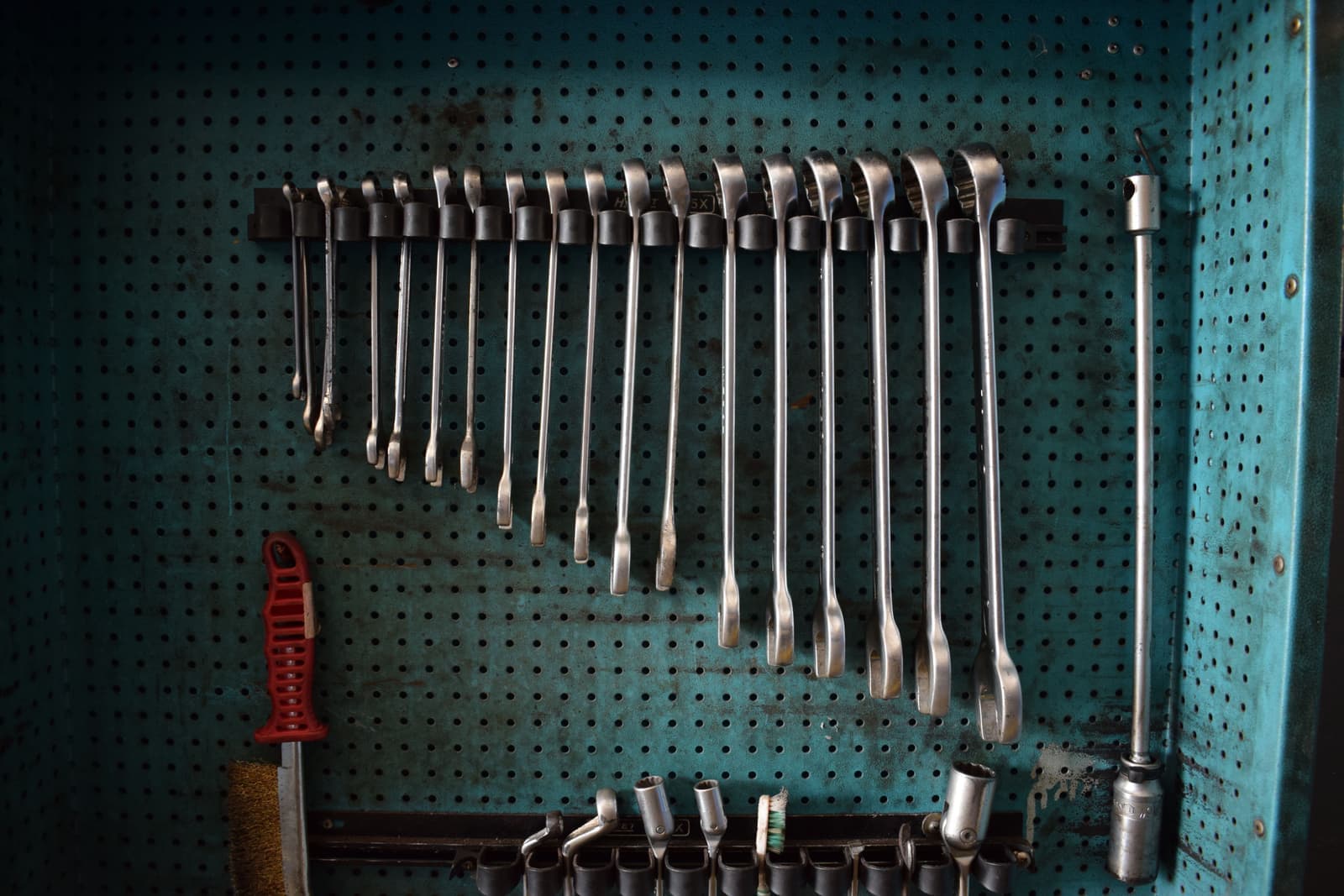
The published limits settle most of it. A mid-range chest drawer is rated at 120 lb per pair; a pegboard hook is rated at 10-15 lb engaging two slots and a whole steel panel at 100 lb into drywall. Pegboard is for hand tools you touch daily. A chest is for everything else, and for anything heavy.
Where you can actually buy each one
| Brand | Where it is sold | Do we earn anything? |
|---|---|---|
| Metal pegboard (Wall Control and similar) | Amazon and the big-box retailers | Yes, on the Amazon listings |
| Tool chests and rolling cabinets | Amazon, Home Depot, Lowe's, Harbor Freight - brand dependent | Yes, on the Amazon listings only |
We say this on every comparison because it changes what our recommendation is worth to you. Where we earn nothing, there is no commercial reason for us to steer you anywhere.
The numbers, which are further apart than people expect
| Pegboard (20 ga steel) | Tool chest | |
|---|---|---|
| Load, per element | 10-15 lb per two-slot hook; 5-10 lb single-slot; 2 lb per plastic bin | 120-150 lb per drawer pair, before the published 80 percent derate |
| Load, per unit | Up to 100 lb per panel into drywall, up to 200 lb into studs | 3,000 lb total on a published 56 in set |
| Visibility | Total. Everything is in sight at once | None until you open a drawer |
| Dust and damp | Everything is exposed | Closed, though that brings its own condensation problem |
| Floor space | Zero - it is wall | A 56 in cabinet wants about five feet of wall plus standing room |
| Security | None | Barrel or tubular locks, as a deterrent |
| Reconfiguring | Minutes, with no tools | The drawer layout is permanent |
Wall Control publishes its limits panel-by-panel and hook-by-hook, which is more disclosure than most tool chests offer. Traditional hardboard pegboard holds considerably less than the steel figures above.
What the hook rating actually rules out
Ten to fifteen pounds is a hammer, a hand saw, a level, a set of pliers. It is not a cordless drill with a battery in it, not a grinder, and not a socket set in its case. That single number defines the category, and almost nobody looks it up before loading a wall.
The 2 lb per plastic bin figure is the one people meet without noticing - a bin filled with fasteners passes it easily, and the failure is the bin clip rather than the board. If you want parts on the wall, a screwed-on drawer cabinet is the better answer than pegboard bins.
Quick picks
Ranked on published specifications, not on hype. The key number is the figure that decides each pick, quoted from the maker. Tap a row for the full write-up, or go straight to the listing.
| # | Product | Best for | Key number | Price |
|---|---|---|---|---|
| 1 |  Wall Control metal pegboard20-gauge steel rather than hardboard, and Wall Control publishes the load limits panel by panel and hook by hook - which is more honest disclosure than most tool chests manage. | Pegboard that publishes what it holds | 20 gasteel panel | $38.99 · Check on Amazon |
| 2 | HuskyNo photo Husky 56 in. 18-drawer comboStill the most completely documented 56-inch combo in the category - 19-gauge body, 120 lb soft-close drawers, 3,000 lb rated, 604 lb empty on six 5 x 2 in casters, all published in one place. The catch as of September 2026 is the route: the Amazon listings have lapsed and it is a Home Depot purchase. | The one-and-done garage upgrade, if you can get to a Home Depot | 19 gabody steel | Check price on Amazon |
| 3 | MilwaukeeNo photo Milwaukee 46 in. top chestA top chest, not a standalone: 18-gauge steel, 100 lb soft-close drawers and a published 1,000 lb hold. 15,877 cubic inches is about 9.2 cubic feet, which is the number worth converting before you decide it is enough. | Adding drawers on top of a cabinet you already own | 15,877 cu instorage volume | Check price on Amazon |
Every key number is a figure the manufacturer publishes. Where a maker publishes none, the row says so rather than substituting an estimate of ours.
Top pick · Pegboard that publishes what it holds
Wall Control Galvanized Metal Pegboard Panel, 32 x 16 in.
20-gauge steel rather than hardboard, and Wall Control publishes the load limits panel by panel and hook by hook - which is more honest disclosure than most tool chests manage.
- Body steel
- 20 ga0.0359 in (0.91 mm)
- Per drawer
- Not published
- Storage
- Not published
- Empty weight
- Not published
What works
- Published load limits for the panel, the hooks, the shelves and the bins - nobody else in this category does that
- 20-gauge steel, which the maker states is over ten times stronger than conventional pegboard
- Takes standard 1/4 in pegs as well as its own slotted accessories, so existing hooks are not wasted
- Steel does not blow out around a hole the way hardboard does when a hook is loaded
What does not
- 100 lb per panel into drywall is the realistic ceiling, and it is easy to exceed with hand tools
- 2 lb per plastic bin is a genuine limit - a bin of fasteners passes it quickly
- A 32 x 16 panel does not go far; a useful wall is several of them
- Everything on it is exposed to dust, and in a damp garage that means surface rust
| Published specification | |
|---|---|
| Panel | 32 in x 16 in, 20-gauge galvanized steel |
| Panel capacity | Up to 100 lb into drywall with the included anchors; up to 200 lb into studs |
| Shelf assemblies | 10-20 lb each, evenly distributed |
| Hooks | 10-15 lb for a two-slot hook; 5-10 lb for a single-slot hook |
| Plastic bins | 2 lb each |
| Compatibility | Accepts 1/4 in pegboard pegs and Wall Control slotted accessories |
| Where it is sold | Amazon, plus other retailers |
Who it is for
The tools you reach for constantly, kept visible at arm's length above a bench.
What it is not for
Heavy tools, anything you want protected from dust, or a wall without studs.
2 · The one-and-done garage upgrade, if you can get to a Home Depot
Husky 56 in. 18-Drawer Professional Tool Chest and Cabinet Set
Still the most completely documented 56-inch combo in the category - 19-gauge body, 120 lb soft-close drawers, 3,000 lb rated, 604 lb empty on six 5 x 2 in casters, all published in one place. The catch as of September 2026 is the route: the Amazon listings have lapsed and it is a Home Depot purchase.
- Body steel
- 19 ga0.0418 in (1.06 mm)
- Per drawer
- 120 lb96 lb working
- Storage
- 24.8 cu ft42,876 cu in
- Empty weight
- 604 lb101 lb per caster, empty
What works
- Publishes a real body gauge, which most listings in this category simply do not
- 120 lb per drawer is genuinely usable: a full 200-piece socket set is around 24 lb
- Six casters rather than four spreads a 600 lb empty weight over more contact points
- Barrel-key locks on both the chest and the cabinet
What does not
- No live Amazon listing right now, so this is a Home Depot trip rather than a delivery you can order from here
- 604 lb empty is a two-person, ramp-and-straps delivery problem
- Husky is a Home Depot house brand, so availability has always come and gone
- 56 in wide plus caster overhang needs about 5 ft of clear wall
| Published specification | |
|---|---|
| Body steel | 19 gauge |
| Drawers | 18 (6-drawer top chest over a 12-drawer cabinet) |
| Per-drawer rating | 120 lb soft-close; deep bottom drawers run dual glides |
| Total capacity | 3,000 lb |
| Empty weight | 604 lb |
| Storage volume | 42,876 cu in |
| Casters | Six, 5 in x 2 in |
| Power | Two power centers, 6 outlets and 2 USB |
| Where to buy | The Home Depot. No live Amazon listing as of September 2026. |
| Where it is sold | The Home Depot |
Who it is for
Someone buying the last box they intend to buy for a decade, with a garage bay to put it in and a Home Depot they can reach.
What it is not for
Anyone who needs it delivered from an online listing today, or who has less than five feet of wall.
No buy button, on purpose
This is sold through The Home Depot rather than Amazon. There is no affiliate link we can build for it, so there is no button here — and no commercial reason for us to push you toward or away from it. How this site is funded.
Sources for this entry
3 · Adding drawers on top of a cabinet you already own
Milwaukee High Capacity 46 in. 8-Drawer Top Chest (48-22-8541)
A top chest, not a standalone: 18-gauge steel, 100 lb soft-close drawers and a published 1,000 lb hold. 15,877 cubic inches is about 9.2 cubic feet, which is the number worth converting before you decide it is enough.
- Body steel
- 18 ga0.0478 in (1.21 mm)
- Per drawer
- 100 lb80 lb working
- Storage
- 9.2 cu ft15,877 cu in
- Empty weight
- Not published
What works
- Publishes gauge, slide rating, total hold and volume - all four, which is rare
- Matches the 46 in cabinet exactly, so the stack lines up
- Soft close on every drawer, not just the deep ones
What does not
- It is a top chest: it needs a cabinet or a bench under it
- No listed empty weight, so you cannot check what the cabinet beneath is carrying
- 100 lb drawers cap what the deep bottom drawer is really for
| Published specification | |
|---|---|
| Body steel | 18 gauge |
| Dimensions | 46.06 in W x 22.13 in D x 23.35 in H |
| Drawers | 8 |
| Per-drawer rating | 100 lb soft close |
| Total hold | 1,000 lb |
| Storage volume | 15,877 cu in (about 9.2 cu ft) |
| Where it is sold | Amazon, plus other retailers |
Who it is for
Someone with a cabinet or a bench and not enough shallow drawers.
What it is not for
A first purchase - a top chest on the floor is a bad box at a bad height.
Sources for this entry
Hardboard versus steel is a bigger gap than chest brands
The traditional brown hardboard pegboard and a 20-gauge steel panel share a name and a hole pattern and very little else. Wall Control states its steel panels are over ten times stronger than conventional pegboard, and the failure mode is the thing to picture: hardboard blows out around the hole and drops the hook, taking the tool with it.
If you are going to hang tools where you stand, that difference is worth more than most of the specification arguments elsewhere on this site. It is also why the published figures above are for steel - hardboard publishes essentially nothing.
What each one is genuinely bad at
- Pegboard cannot hold weight. Anything past about 15 lb needs a different solution, and that is most power tools.
- Pegboard leaves everything exposed to dust and damp, which in an unheated garage means surface rust on bare steel.
- A chest shows you nothing until you open it, so the tools you use constantly are behind a drawer front you open forty times a day.
- A chest costs floor space - about five feet of wall plus standing room for a 56 in cabinet, which a wall of pegboard costs nothing.
- A chest is permanent. The drawer layout you buy is the drawer layout you keep; a pegboard rearranges in minutes.
The honest answer is both, in a specific arrangement
Pegboard above the bench for the twenty tools you touch every session - screwdrivers, pliers, a hammer, a tape, a square. Chest below or beside it for everything heavy, everything in sets, and everything you would rather not have collecting dust.
That arrangement plays to both: instant retrieval where retrieval speed matters, real capacity where weight matters. It is also the sequence the storage ideas page recommends, and for the same reason - the wall is cheap and it comes first.
Whatever you hang it on has to be structural
100 lb per panel into drywall with the manufacturer's anchors, up to 200 lb into studs. Those are published figures and they assume the anchors are actually installed as specified. A loaded panel coming off a wall takes the tools and the drywall with it, so find the studs. Pegboard, compared on those published limits goes through metal against hardboard and square holes against round.
Common questions
How much weight can a pegboard hook hold?
Wall Control publishes 10-15 lb for a hook engaging two slots and 5-10 lb for one engaging a single slot, on 20-gauge steel panels. That covers hand tools and rules out most power tools. Traditional hardboard pegboard holds considerably less.
Is metal pegboard better than hardboard pegboard?
Substantially. Wall Control states its 20-gauge steel panels are over ten times stronger than conventional pegboard, and the failure mode matters: hardboard blows out around the hole and drops the hook with the tool on it.
Should I use pegboard or a tool chest?
Both, for different tools. Pegboard above the bench for the twenty things you touch every session, where instant visibility is worth more than capacity. A chest for everything heavy, everything in sets, and everything you would rather keep out of the dust.
Can you put heavy tools on pegboard?
No. The published hook limits are 10-15 lb for a two-slot hook, which covers a hammer or a hand saw and not a cordless drill with a battery in it. Anything heavier belongs in a drawer on rated slides.
Sources
Read next
Garage slatwall, and the load rating nobody in the category publishes
Garage slatwall compared against metal pegboard on the figures that exist - continuous channels and real basket support, against four published load limits it cannot match.
The best pegboard for a garage, judged on what it is rated to hold
Metal pegboard compared on published gauge and load limits - 18 gauge against 20, square holes against round, and what a hook is actually rated for.
Tool storage ideas, in the order that actually pays off
A sequence rather than a gallery: what to fix first, what each format is good at, and the published limits that decide which one your problem needs.
Small parts organizers, and the one that suits how you work
Parts cabinets, sealed bin organizers and tray inserts - three formats for three different problems, compared on published compartment size.
The best tool chests, ranked on what the maker actually publishes
The flagship roundup: chests and cabinets ranked on published gauge, slide ratings and volume, with three things we would actively skip.
Why tools rust in a closed box, and what actually stops it
The condensation mechanism that causes it, the four fixes that actually work, and the folk remedies that do not.
Tool chest vs tool cabinet, and which half to buy first
The terminology settled once, and the reason the cabinet is almost always the half to buy first.