For woodworking
Woodworking benches: a clamping device, not a table
A garage bench holds things up. A woodworking bench holds things still, and that difference is the whole specification: top thickness, vises and dog holes.
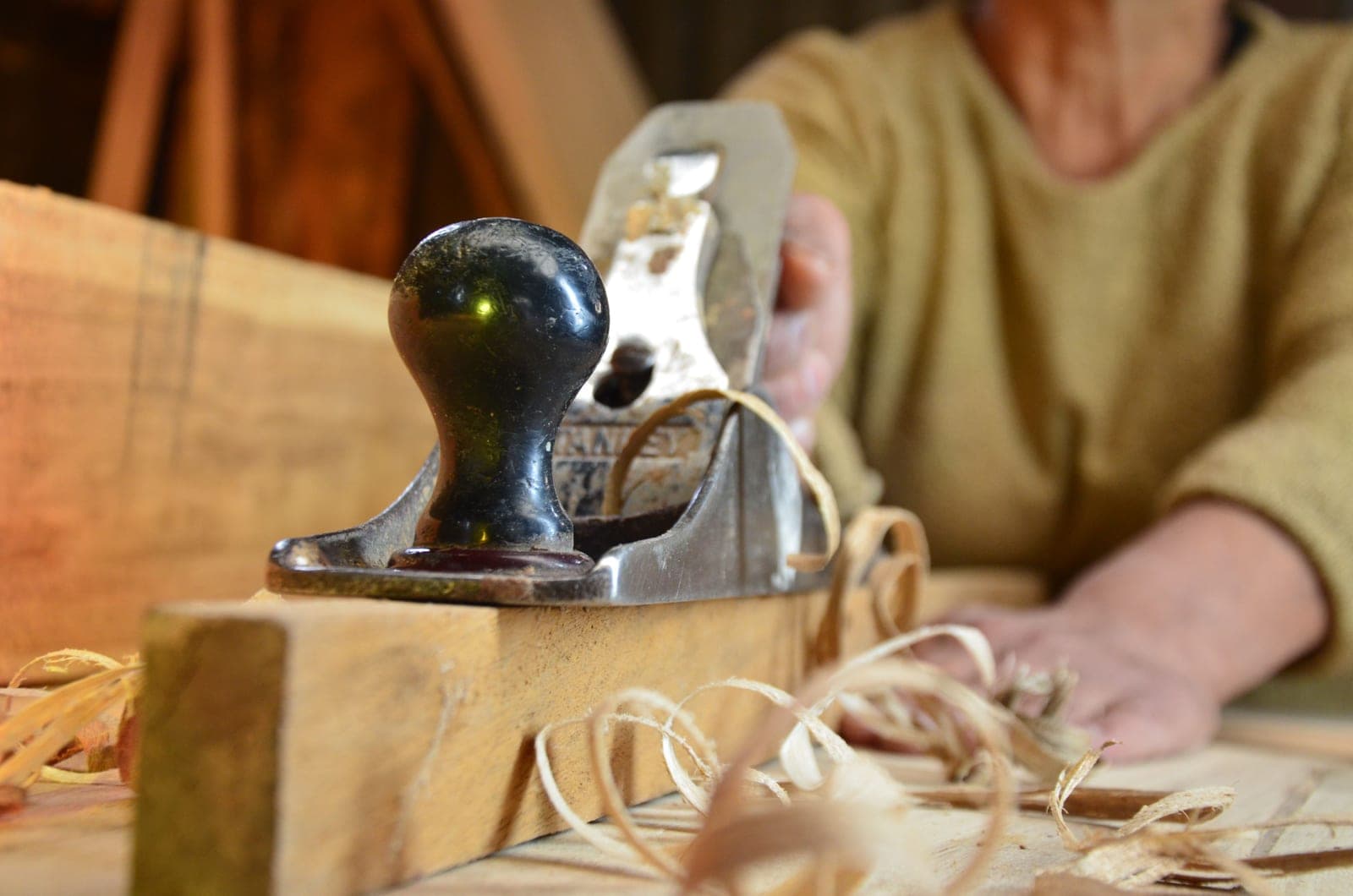
Woodworking benches are decided by top thickness, vises and dog holes, in that order. Published thicknesses here run from 1.5 in to 3-11/32 in of solid beech, and because stiffness rises with the cube of thickness that range spans roughly an order of magnitude in rigidity. Everything else is preference.
Why a woodworking bench is a different machine
A garage workbench is a surface: you put things on it and work above it. A woodworking bench is a clamping device with a flat top attached: you put things IN it - between dogs, under a holdfast, in a vise jaw - and then apply force to them with a hand tool.
Everything odd about the specification follows from that. The top is enormously thick because a holdfast needs material to grip and a dog hole needs depth. The bench is heavy because planing pushes it. The vises are wide because you clamp long boards. None of that makes sense for a bench you assemble a bicycle on, which is why the general garage bench roundup reaches quite different conclusions.
Thickness, and the cube law nobody mentions
Beam stiffness scales with the cube of depth. That single fact explains the entire price ladder in this category and it is almost never stated plainly, so here it is with the numbers from the benches on this page.
| Published top | Relative to 1.5 in | What it means at the bench |
|---|---|---|
| 1.5 in beech (Scandi Plus 1825) | Reference | Genuine workholding, real dog holes, some deflection under a heavy holdfast |
| 3-11/32 in beech (Elite 1500) | About 11 times stiffer | Deflection stops being something you think about; holdfasts bite properly in the extra depth |
| 0.75 in laminated panel | About one eighth as stiff | Flexes under a clamp at the edge and will pull vise fixings out over time |
The comparison is the cube of the thickness ratio, which is how beam stiffness behaves. It is arithmetic on the published figures, not a measurement we took. [More on tops](/specs/workbench-tops).
Quick picks
Ranked on published specifications, not on hype. The key number is the figure that decides each pick, quoted from the maker. Tap a row for the full write-up, or go straight to the listing.
| # | Product | Best for | Key number | Price |
|---|---|---|---|---|
| 1 | 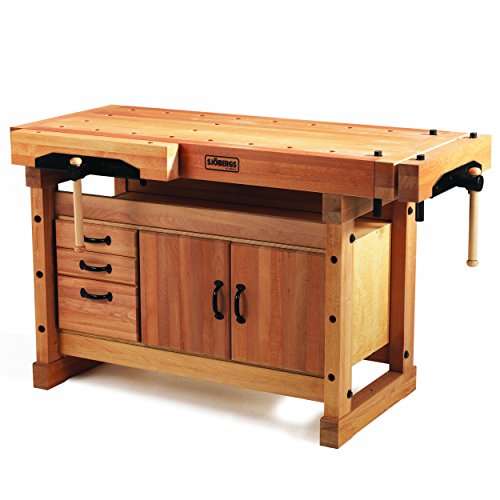 Sjobergs Elite 1500 + cabinetThe thickest published bench top on this site by a wide margin, and because stiffness rises with the cube of thickness it is not in the same conversation as a 1-1/2 in slab. Two vises, dog holes, European beech. The live listing pairs it with its storage cabinet, so you are buying both. | A top thick enough that flex stops being a topic | 3-11/32 inbeech top thickness | $3,400.00 · Check on Amazon |
| 2 | 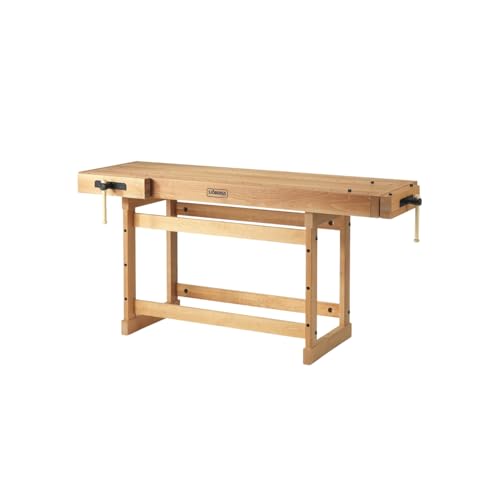 Sjobergs Scandi Plus 1825A 1.5 inch beech top with a reinforced skirt and precisely spaced 3/4 inch dog holes, sold with holdfasts, jaw cushions and an anvil pad. Half the top thickness of the Elite, and the workholding is still genuine. | Real workholding without the Elite's price | 1.5 inbeech top thickness | $1,799.00 · Check on Amazon |
| 3 | 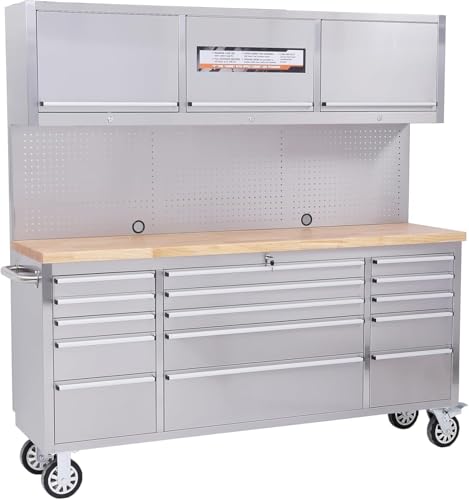 72 in. stainless 15-drawerFifteen drawers under a 72-inch work surface, which is the whole argument for the format: the storage is where the work is rather than across the garage. The cabinet is 430 stainless with an anti-fingerprint finish and the top is solid rubberwood, so the wipe-clean surface here is the carcass rather than the bench top. | A bench that is also a drawer unit | 15drawers under the top | $1,300.00 · Check on Amazon |
| 4 |  B+D Workmate 825The design that invented this category and still publishes the highest number in it: 550 lb, with a top that closes on the work like a vise. The 825 adds vertical clamping and a 29 in jaw to the format, at two working heights. | The one that is also a vise | 550 lbpublished capacity | $385.36 · Check on Amazon |
Every key number is a figure the manufacturer publishes. Where a maker publishes none, the row says so rather than substituting an estimate of ours.
Top pick · A top thick enough that flex stops being a topic
Sjobergs Elite 1500 Beech Workbench with Storage Cabinet Combo
The thickest published bench top on this site by a wide margin, and because stiffness rises with the cube of thickness it is not in the same conversation as a 1-1/2 in slab. Two vises, dog holes, European beech. The live listing pairs it with its storage cabinet, so you are buying both.
- Body steel
- Not published
- Per drawer
- Not published
- Storage
- Not published
- Empty weight
- Not published
What works
- 3-11/32 in of beech is roughly thirty-seven times the stiffness of a 1 in top on the cube rule
- Two vises from the factory, which is the definition of a clamping bench rather than a table
- European beech, dense enough that the dog holes stay round
- The cabinet included in this listing is the storage a bench like this otherwise lacks
What does not
- The most expensive thing on this site, and the combo listing costs more again than the bare bench did
- You cannot currently buy the bench on its own through this listing
- Heavy enough that placement is a one-time decision
- Sjobergs publishes no load capacity for it
| Published specification | |
|---|---|
| Top thickness | 3-11/32 in beech |
| Vises | Two large vises |
| Supplied as | Bench plus the Elite storage cabinet |
| Model | Elite 1500 (SJO-33246) |
| Load capacity | Not published |
| Where it is sold | Amazon, plus other retailers |
Who it is for
Hand-tool woodworking, where a bench that moves under a plane stroke is the whole problem.
What it is not for
Mechanical work, a tight budget, or anyone who wanted the bench without the cabinet.
Sources for this entry
2 · Real workholding without the Elite's price
Sjobergs Scandi Plus 1825 Beech Wood Workbench (SJO-33279)
A 1.5 inch beech top with a reinforced skirt and precisely spaced 3/4 inch dog holes, sold with holdfasts, jaw cushions and an anvil pad. Half the top thickness of the Elite, and the workholding is still genuine.
- Body steel
- Not published
- Per drawer
- Not published
- Storage
- Not published
- Empty weight
- Not published
What works
- 3/4 in dog holes are the standard size, so every aftermarket holdfast and dog fits
- Holdfasts included rather than sold separately, which is unusual
- The reinforced skirt does much of what extra thickness would, at lower weight and cost
- An anvil pad for light metalwork on a wood bench is a genuinely thoughtful inclusion
What does not
- 1.5 in against the Elite's 3-11/32 in is a large stiffness difference, not a small one
- No published overall dimensions in the listing summary
- Beech at this thickness will cup if it is finished on one face only
| Published specification | |
|---|---|
| Top | Beech, 1.5 in thick, with a reinforced skirt |
| Dog holes | 3/4 in, precisely spaced |
| Included | Holdfasts, jaw cushions, anvil pad |
| Where it is sold | Amazon, plus other retailers |
Who it is for
Serious hobby woodworking that needs proper workholding on a realistic budget.
What it is not for
Heavy timber work or anything where you would hammer hard on the top.
Sources for this entry
3 · A bench that is also a drawer unit
72 in. Rolling Tool Chest Workbench, 15 Drawers, 430 Stainless
Fifteen drawers under a 72-inch work surface, which is the whole argument for the format: the storage is where the work is rather than across the garage. The cabinet is 430 stainless with an anti-fingerprint finish and the top is solid rubberwood, so the wipe-clean surface here is the carcass rather than the bench top.
- Body steel
- Not published
- Per drawer
- Not published
- Storage
- Not published
- Empty weight
- Not published
What works
- Fifteen drawers directly under the work surface, so tools are within reach of the job
- 72 inches is a genuine bench length rather than a cabinet with a lid
- A 430 stainless carcass wipes clean of oil and solvent, and the finish is specified to resist fingerprints
- Rolls, so it can be pulled away from the wall to work behind
What does not
- Publishes no gauge, no per-drawer rating and no total capacity
- No published top thickness, which is the one figure that governs how a bench behaves under load
- Fifteen drawers at this price means shallow drawers - check the internal depths against your longest tool
- A rolling bench moves under a hand plane; this is an assembly and mechanical bench, not a joinery one
| Published specification | |
|---|---|
| Top | Solid rubberwood; thickness not published |
| Cabinet | 430 stainless, anti-fingerprint finish |
| Width | 72 in |
| Drawers | 15, key lock |
| Casters | Lockable wheels; count not published |
| Body steel | Not published |
| Per-drawer rating | Not published |
| Total capacity | Not published |
| Where it is sold | Amazon, plus other retailers |
Who it is for
A garage where the bench and the tool storage should be the same object.
What it is not for
Hand-tool woodworking, or anyone comparing benches on published numbers.
Sources for this entry
4 · The one that is also a vise
BLACK+DECKER Workmate 825 Deluxe Dual-Height Workbench (WM825)
The design that invented this category and still publishes the highest number in it: 550 lb, with a top that closes on the work like a vise. The 825 adds vertical clamping and a 29 in jaw to the format, at two working heights.
- Body steel
- Not published
- Per drawer
- Not published
- Storage
- Not published
- Empty weight
- 41.9 lb
What works
- The clamping top is a genuine vise, which no other folding bench here offers
- 550 lb published is nearly double the WORX in table mode
- Vertical clamping, which the older Workmates could not do
- The design has been made essentially unchanged for decades, so parts and knowledge exist
What does not
- About 41.9 lb, which is heavier than the WORX and you feel it carrying it
- The clamping top is the work surface, so a small flat area is all you get
- Two fixed heights rather than an adjustable range
- Dimensions are published in millimeters on the maker's own page, so convert before planning a space
| Published specification | |
|---|---|
| Capacity | 550 lb (250 kg) |
| Weight | About 41.9 lb (19 kg) |
| Working heights | Two - about 31.5 in and 24.4 in |
| Vise jaw opening | 0 to about 8.1 in |
| Vise jaw length | About 29.1 in |
| Jaw positions | Three, plus vertical clamping |
| Modes | Workbench, bench tool stand, vise, sawhorse |
| Where it is sold | Amazon, plus other retailers |
Who it is for
Anyone who wants a portable surface that can also hold the work still.
What it is not for
Large sheet goods. The usable flat area is small by design.
How we picked
- Published top thickness, first and by a distance. Beam stiffness rises with the CUBE of thickness, so a 3-11/32 in top is not twice a 1.5 in top - it is roughly eleven times stiffer. Nothing else on the spec sheet moves the needle like this.
- Vises: how many, how wide, and are they included? On a woodworking bench the vises are most of the value and most of the price. A bench sold without them is a table.
- Dog holes: size and spacing. 3/4 in is the standard that every aftermarket holdfast and dog fits. Dual rows let you clamp across the bench as well as along it.
- Workholding accessories included. Holdfasts, dogs and jaw cushions add up fast when bought separately.
- Weight, which is a feature here. A light bench walks across the shop when you plane on it. Mass is the point.
What we did not do
Everyone in this category says they spent seventy-five hours testing tool chests. We have not opened any of these boxes, and we say so. What we do instead: compile the published specs, convert the steel gauges, multiply out the slide ratings, cite the maker’s own listing, and show the arithmetic so you can check it. The full method, including how to challenge a figure.
What we would skip
A list with no losers is a list nobody edited. These are the choices we would actively steer you away from, and why.
A steel bench for woodworking
It marks the work, it is loud enough to be unpleasant to hand-plane on, and you cannot bore a dog hole in it or drive a holdfast into it. Steel is right for automotive and metalwork and wrong here, and the reason is workholding rather than taste.
A thin top with a vise bolted to it
A vise transfers its load into the top, and a 3/4 in laminated panel flexes and eventually pulls its fixings. If the listing does not publish a thickness, assume it is thin - makers who spent money on a thick top say so in the first line.
A bench light enough to move easily
This is the counterintuitive one. Weight is a feature on a woodworking bench: hand-planing pushes the bench away from you, and mass is what stops it. A bench you can pick up alone is a bench that skids when you work on it.
Dog holes: the spec that quietly decides your accessories
A dog hole is a hole in the top that takes a bench dog or a holdfast, and the diameter is a standard rather than a preference. 3/4 inch is the size the aftermarket is built around - holdfasts, dogs, planing stops and clamping accessories are all made for it. A bench with an unusual hole size works fine and then quietly limits every accessory purchase you make afterwards.
Spacing and layout matter nearly as much. A single row along the front edge lets you clamp along the bench. Dual rows let you clamp across it as well, which is what you need for anything wider than a board - and the Elite publishes dual rows where most benches have one.
Vises, and why they are most of the price
A woodworking vise is a precision screw mechanism with wide jaws that has to close parallel under load. That is a genuinely harder thing to make than a bench top, and it is why a bench sold with two 23.5 inch vises costs what it does.
One detail worth calling out because it is rare: the Elite's front vise is fully reversible for left-handed work. Left-handed woodworkers normally accept a bench built for someone else, and a maker publishing that accommodation is worth noting.
Check the height against your own body, not the category
Woodworking is the one discipline where published guidance says to go LOW - heavy work like planing wants the top well below elbow height so you can get your weight over the tool. That is a different number from the general-bench answer, and it is personal. Run your own height through the calculator before you buy a bench you cannot adjust.
If the budget is not there yet
A folding bench with a clamping top is the honest entry point, and it is on this list for that reason rather than as a courtesy. It publishes a real capacity, it holds work between its jaws, and it costs a small fraction of a beech bench. What it does not give you is mass, dog holes or a flat area of any size.
Which is the right trade for occasional work and the wrong one if you are hand-planing regularly. Portable and folding benches covers that category properly.
Common questions
How thick should a woodworking bench top be?
Published tops in this category run from 1.5 in to 3-11/32 in of solid beech. Because beam stiffness rises with the cube of thickness, that range is roughly an order of magnitude in rigidity - a 3-11/32 in top is about eleven times stiffer than a 1.5 in one.
What size dog holes should a workbench have?
3/4 inch. It is the size the aftermarket is built around, so every standard holdfast, bench dog and planing stop fits. An unusual diameter works fine on day one and limits every accessory purchase afterwards.
Can you use a steel workbench for woodworking?
You can, and it fights you. Steel marks the work, it is loud to hand-plane beside, and you cannot bore a dog hole or drive a holdfast into it - which removes most of a woodworking bench's workholding. Steel is right for automotive and metalwork instead.
Should a woodworking bench be heavy?
Yes, and it is the one category where weight is a feature rather than a cost. Hand-planing pushes the bench away from you and mass is what resists it. A bench light enough to move easily is a bench that skids under a plane.
Sources
Read next
The best bench vises, and the number buyers skip
Four bench vises compared on throat depth, jaw opening and swivel - including the fourfold throat gap between two vises sold at similar sizes.
The best workbench tops, and the slabs that will not tell you how thick they are
Four slabs sold as workbench tops, compared on the one number that decides a bench top - and the two that decline to publish it.
Workbench tops: thickness first, then material
Why thickness beats material, the five surfaces compared, and the vise-mounting check that is not retrofittable.
Workbench height, worked out from your own body
The elbow-height rule, a table by height and task, a calculator, and the four things that silently change the number.
Folding workbenches, for a garage with no room for a bench
Folding benches on published capacity, carry weight and folded depth - and why the headline 1,000 lb figure is not the one that applies to you.
The best garage workbenches, judged on the top and the height
Benches ranked on published top thickness and rated load, with the height calculation that decides whether any of them suits your body.
How to choose a workbench, in the order that matters
Height first because it is the only spec about you, then top thickness, depth, and whether drawers belong in the same purchase.