The value tier
Best workbenches under $300, and the one number the price cuts first
Under three hundred dollars you can have a rigid top, a useful height range or a vise slot. The benches that publish their top thickness are a short list, and that is the whole story of this bracket.
The WORKPRO 48 in. adjustable is the pick: it is the only bench in the bracket that publishes its top thickness (1-3/16 in) and adjusts through 31-1/2 to 39-3/8 in, which spans the published elbow-height guidance for most adults. Buy the Olympia 60 in. instead if you want dog holes and a vise slot from the factory.
What three hundred dollars actually buys
It buys a solid hardwood top - rubberwood or birch, not chipboard - on a steel or hardwood frame, somewhere between 48 and 60 inches long and about 20 inches deep. That is a genuinely useful bench and it is considerably more than the bracket bought five years ago.
What it does not buy is thickness. Every bench here sits between 1 in and 1-3/16 in of top, against the 1-1/2 in that the purpose-built bench tops start at and the 3-11/32 in that the top of the woodworking market reaches. That gap is not cosmetic. Beam stiffness rises with the cube of thickness, so the difference between an inch and an inch and a half is roughly a factor of three in how much the top deflects under the same load.
The cube rule, in one line
Double the thickness and you get about eight times the stiffness. Go from 1 in to 1-1/2 in - a fifty percent increase - and you get about three and a third times the resistance to deflection. This is why top thickness is the first number to look for and the first one budget listings leave out.
Quick picks
Ranked on published specifications, not on hype. The key number is the figure that decides each pick, quoted from the maker. Tap a row for the full write-up, or go straight to the listing.
| # | Product | Best for | Key number | Price |
|---|---|---|---|---|
| 1 |  WORKPRO 48 in. adjustableThe only bench in this bracket that publishes its top thickness AND adjusts through the range the elbow-height rule actually calls for: 31-1/2 in to 39-3/8 in covers general work for a short adult through precision assembly for a tall one. The 2,000 lb capacity is the claim to treat carefully. | Height that adjusts to the person, not the room | 1-3/16 inpublished top thickness | $172.79 · Check on Amazon-10% |
| 2 |  Olympia 60 in. rubberwood benchThe only bench in this bracket that arrives with woodworking provision already made: 16 bench dog holes, a vise slot and a published 7 in vise capacity, on a solid rubberwood top. Olympia also splits the capacity honestly - 250 lb on the top and 200 lb on the bottom shelf rather than one flattering total. | Dog holes and a vise slot at this price | 16bench dog holes | $286.99 · Check on Amazon |
| 3 |  Seville UltraGraphite 48 in.Seville publishes more about this bench than anyone else in the bracket publishes about theirs: 500 lb total, 30 lb in the drawer, a 1 in top, 83.6 lb empty and four 3 in wheels with two locking. The 1 in top is the compromise, and it is a real one. | The only one here that rolls | 500 lbpublished capacity | $259.99 · Check on Amazon |
| 4 | 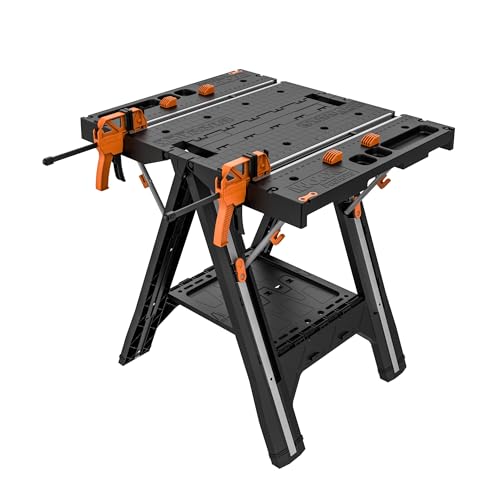 WORX Pegasus WX051WORX publishes two capacities because it is two things: 300 lb as a work table and 1,000 lb in sawhorse mode. At 25 lb and folding to about 5 inches, it is the bench for a garage that has no room for a bench. | Two tools in one, folded flat against a wall | 300 / 1,000 lbtable / sawhorse | $139.92 · Check on Amazon |
Every key number is a figure the manufacturer publishes. Where a maker publishes none, the row says so rather than substituting an estimate of ours.
Top pick · Height that adjusts to the person, not the room
WORKPRO 48 in. Adjustable Workbench, Rubberwood Top
The only bench in this bracket that publishes its top thickness AND adjusts through the range the elbow-height rule actually calls for: 31-1/2 in to 39-3/8 in covers general work for a short adult through precision assembly for a tall one. The 2,000 lb capacity is the claim to treat carefully.
- Body steel
- Not published
- Per drawer
- Not published
- Storage
- Not published
- Empty weight
- Not published
What works
- Publishes the top thickness, which two of the slabs and one of the benches on this site do not
- The adjustment range spans the published elbow-height guidance rather than sitting at one fixed height
- 1.3 mm frame steel is published, which is more than most bench makers state at any price
- Outlets built in, so the extension lead stops living on the floor
What does not
- 2,000 lb on a 1.3 mm frame is a large claim with no test standard named against it
- 1-3/16 in is thinner than the 1-1/2 in slabs, and stiffness scales with the cube of thickness
- 20 in deep is shallow, and an adjustable frame is never as rigid as a fixed one
- No vise provision and no dog holes
| Published specification | |
|---|---|
| Size | 48 in x 20 in top |
| Top | FSC-certified solid rubberwood, 1-3/16 in thick |
| Height | Adjustable, 31-1/2 in to 39-3/8 in |
| Published capacity | 2,000 lb |
| Frame | 1.3 mm steel |
| Power | ETL-certified strip, 4 AC outlets and 2 USB-A |
| Where it is sold | Amazon, plus other retailers |
Who it is for
One bench used by people of different heights, or for tasks that want different heights.
What it is not for
Hand-tool woodworking, where racking under a plane stroke is the thing a fixed frame prevents.
2 · Dog holes and a vise slot at this price
Olympia Tools 60 in. Rubberwood Workbench with 2 Storage Shelves
The only bench in this bracket that arrives with woodworking provision already made: 16 bench dog holes, a vise slot and a published 7 in vise capacity, on a solid rubberwood top. Olympia also splits the capacity honestly - 250 lb on the top and 200 lb on the bottom shelf rather than one flattering total.
- Body steel
- Not published
- Per drawer
- Not published
- Storage
- Not published
- Empty weight
- Not published
What works
- 16 dog holes and a vise slot from the factory, which nothing else in this bracket offers
- Publishes the capacity split by surface rather than quoting one headline number
- 34 in high suits general bench work for most adults without modification
- Solid rubberwood rather than a laminate over particle board
What does not
- Does not publish the top thickness, and on a woodworking bench that is the governing number
- 250 lb on the top is modest once an engine part or a bench grinder lands on it
- 20 in deep is shallow for assembly work
- No vise included - the slot is provision, not a vise
| Published specification | |
|---|---|
| Size | 60 in L x 20 in W x 34 in H |
| Top | Solid rubberwood with protective varnish |
| Capacity | 450 lb total - 250 lb top, 200 lb bottom shelf |
| Dog holes | 16, with 4 metal and 4 wood pegs supplied |
| Vise | Vise slot, 7 in capacity |
| Storage | Two integrated shelves |
| Top thickness | Not published |
| Where it is sold | Amazon, plus other retailers |
Who it is for
A first woodworking bench where clamping matters and the budget is fixed.
What it is not for
Heavy mechanical work, or anyone who needs a published top thickness.
3 · The only one here that rolls
Seville Classics UltraGraphite 48 in. Wood Top Workbench on Wheels with Sliding Drawer
Seville publishes more about this bench than anyone else in the bracket publishes about theirs: 500 lb total, 30 lb in the drawer, a 1 in top, 83.6 lb empty and four 3 in wheels with two locking. The 1 in top is the compromise, and it is a real one.
- Body steel
- Not published
- Per drawer
- 30 lb24 lb working
- Storage
- Not published
- Empty weight
- 83.6 lb21 lb per caster, empty
What works
- Publishes total capacity, drawer capacity, top thickness AND empty weight - the fullest disclosure in this bracket
- Full-extension ball-bearing slides on the drawer rather than friction glides
- 24 in deep, which is 4 in more usable bench than most of the budget field
- Rolls, and two locking casters mean it stops rolling when you are working
What does not
- A 1 in top is the thinnest here, and beam stiffness scales with the cube of thickness
- 37 in high is above the published elbow-height guidance for most adults doing general work
- 30 lb in the drawer is a light rating - that is a socket set and not much else
- Wheels trade rigidity for mobility; a rolling bench moves under a hand plane
| Published specification | |
|---|---|
| Size | 48 in W x 24 in D x 37 in H |
| Top | Solid polyurethane-coated wood, 1 in thick |
| Total capacity | 500 lb |
| Drawer | One steel drawer, 30 lb rated, full-extension ball-bearing slides |
| Drawer interior | 33.5 in W x 17.25 in D x 3.5 in H, with two adjustable dividers |
| Empty weight | 83.6 lb |
| Casters | Four 3 in wheels, two locking |
| Where it is sold | Amazon, plus other retailers |
Who it is for
A garage where the bench has to move out of the way of a car.
What it is not for
Hand-tool woodworking, or anything that needs a rigid, thick top at a set height.
4 · Two tools in one, folded flat against a wall
WORX Pegasus Folding Work Table and Sawhorse (WX051)
WORX publishes two capacities because it is two things: 300 lb as a work table and 1,000 lb in sawhorse mode. At 25 lb and folding to about 5 inches, it is the bench for a garage that has no room for a bench.
- Body steel
- Not published
- Per drawer
- Not published
- Storage
- Not published
- Empty weight
- 25 lb
What works
- Publishes both capacities separately rather than quoting the flattering one
- Folds to about 5 inches, so it stores behind a door instead of taking a wall
- Clamp dogs and quick clamps included, so it holds work out of the box
- 25 lb means one person carries it up a ladder-less flight of stairs
What does not
- 300 lb in table mode is well under a fixed bench, and it is the mode you use most
- 32 in high is below elbow height for most adults and it does not adjust
- Nothing to bolt a vise to permanently
| Published specification | |
|---|---|
| Dimensions | 31 in x 25 in x 32 in |
| Capacity, table mode | 300 lb |
| Capacity, sawhorse mode | 1,000 lb |
| Weight | 25 lb |
| Folded depth | About 5 in |
| Included | 2 quick clamps and 4 clamp dogs |
| Where it is sold | Amazon, plus other retailers |
Who it is for
A garage with no spare wall, or work that happens somewhere other than the garage.
What it is not for
A permanent bench. Folding legs and a fixed low height are the price of portability.
Sources for this entry
How we picked
- Published top thickness first. Beam stiffness rises with the cube of thickness, so 1-1/2 in is roughly three times as rigid as 1 in, not fifty percent more. It is the number that decides a bench and it is the first one omitted from a budget listing.
- Height against the elbow-height rule. About elbow height for general work, 2-4 in above for precision assembly, well below for heavy work. A fixed bench at the wrong height is a bench you stoop at for a decade.
- Capacity, and whether a test standard is named. Several benches in this bracket publish four-figure capacities with no stated test behind them. Published is better than unpublished; published with a method is better again, and nobody here does that.
- Provision for a vise. A vise slot and dog holes from the factory are worth real money, because retrofitting either into a thin top is a poor outcome.
- Depth. Twenty inches is shallow for assembly work and is what most of this bracket gives you. Twenty-four is noticeably better and costs more.
What we did not do
Everyone in this category says they spent seventy-five hours testing tool chests. We have not opened any of these boxes, and we say so. What we do instead: compile the published specs, convert the steel gauges, multiply out the slide ratings, cite the maker’s own listing, and show the arithmetic so you can check it. The full method, including how to challenge a figure.
The capacity claims, and how to read them
This bracket has a numbers problem. The WORKPRO publishes 2,000 lb on a 1.3 mm steel frame. Other benches at similar money publish 2,500 lb. The Olympia, at the same price, publishes 450 lb - and splits it honestly into 250 lb on the top and 200 lb on the bottom shelf.
The Olympia is almost certainly not five times weaker than its competitors. It is more likely the only one quoting a figure it would be comfortable defending. A capacity claim with no named test standard, no load distribution and no deflection limit is not a specification, it is a number in a listing - and the sensible response is to compare the benches on the things that are physically checkable instead: thickness, depth, frame material and height.
| Bench | Top thickness | Size | Height | Published capacity |
|---|---|---|---|---|
| WORKPRO 48 in. adjustable | 1-3/16 in rubberwood | 48 x 20 in | 31-1/2 to 39-3/8 in | 2,000 lb |
| Olympia 60 in. rubberwood | Not published | 60 x 20 in | 34 in fixed | 450 lb (250 top, 200 shelf) |
| Seville UltraGraphite 48 in. | 1 in | 48 x 24 in | 37 in fixed | 500 lb (30 lb drawer) |
| WORX Pegasus | Not applicable | 31 in work surface | Fixed, folding | 300 lb table / 1,000 lb sawhorse |
Published figures from each maker. 'Not published' means we checked the maker's page and the number is not there.
Height is the decision people regret
Two of the four benches here have a fixed height, and one of those is 37 in - above the elbow-height guidance for most adults doing general work. A bench that is two inches too tall is a bench you lift your shoulders at, every time, for as long as you own it.
This is the strongest argument for the adjustable bench in a bracket where adjustability normally costs rigidity. Work out your own bench height before shortlisting - it takes a minute, it is derived from your standing height, and it eliminates benches from the list faster than any other filter.
Vise provision is worth more than it costs
The Olympia arrives with 16 dog holes, a vise slot and a published 7 in vise capacity. Nothing else in this bracket offers any of that, and retrofitting it is not a small job: drilling accurate 3/4 in dog holes into a thin top without a guide is how you end up with a top that is neither flat nor square, and bolting a vise to an inch of rubberwood needs backing you have to build.
If the bench is for woodworking, that provision decides the purchase on its own. If it is for mechanical work, it is worth nothing and the adjustable height is worth more. Woodworking benches covers the clamping side properly, and the honest summary there applies here: a woodworking bench is a clamping device, not a table.
What to check before ordering
- Your elbow height, and the bench height against it. Fixed-height benches are eliminated or confirmed by this one check.
- Whether the top thickness is published at all. If it is not, you are buying an unknown on the number that matters most.
- Depth against what you assemble. Twenty inches is fine for a vise and a grinder and cramped for anything laid out flat.
- Whether the frame bolts through the top or clamps it. Bolted is stiffer and it is rarely stated, so look at the photographs.
- Assembly. Nearly everything in this bracket ships flat, and a bench assembled loose stays loose.
What we would skip
A list with no losers is a list nobody edited. These are the choices we would actively steer you away from, and why.
Any bench under $300 that does not publish its top thickness
It is one number, it costs nothing to print, and it governs how the bench behaves under every load you will put on it. A listing that gives you a four-figure capacity and no thickness has chosen the flattering number over the useful one.
Particle board with a laminate face
It looks like a worktop until something wet sits on it or a corner takes a knock, and then it swells and never recovers. Solid rubberwood and birch are genuinely available in this bracket - there is no reason to accept a chipboard core.
A four-figure capacity claim with no named test
Two of the benches in this bracket claim 2,000 lb and 2,500 lb on frames whose steel is 1.3 mm or unpublished. The claim may be true under some static, evenly distributed condition nobody describes. Treat it as marketing, and judge the bench on thickness and depth instead.
Folding benches, if you wanted a bench
A folding work table is a genuinely useful thing and it is not a workbench. It flexes, it is narrow, and it is designed to be put away. Buy one because you have no room for a bench, not because it was cheaper than one.
The honest verdict
Under $300 the real choice is between a bench that fits your body and a bench that clamps your work. The WORKPRO adjusts to you; the Olympia clamps. Both publish more about themselves than most of the bracket, which is the reason they are the two picks.
If neither fits, the honest answer is that a bench top and a base bought separately will beat anything assembled in this bracket - bench tops, compared has the slabs, starting at a published inch and a half.
Common questions
What is the best workbench under $300?
The WORKPRO 48 in. adjustable, on published specifications: it is the only bench in the bracket that publishes its top thickness (1-3/16 in solid rubberwood) and its height adjusts from 31-1/2 to 39-3/8 in, covering the elbow-height guidance for most adults. The Olympia 60 in. is the pick instead if you want dog holes and a vise slot included.
How thick should a workbench top be?
Thicker than anything in this price bracket, ideally. Stiffness rises with the cube of thickness, so 1-1/2 in is about three and a third times as rigid as 1 in. Budget benches run 1 in to 1-3/16 in; purpose-built bench tops start at 1-1/2 in and published beech woodworking tops reach 3-11/32 in.
Are 2,000 lb workbench capacity claims real?
They are unverifiable rather than provably false. No maker in this bracket names a test standard, a load distribution or a deflection limit alongside the number. Compare on the checkable figures instead - top thickness, depth, frame material and height - and treat a four-figure capacity on a thin frame as marketing.
Is a folding workbench good enough?
For a garage with no room for a fixed bench, yes, and the WORX Pegasus publishes 300 lb as a table and 1,000 lb as a sawhorse. It is not a substitute for a bench: it flexes, it is narrow, and it is designed to be put away. Buy it for the space constraint, not the price.
Sources
Read next
How to choose a workbench, in the order that matters
Height first because it is the only spec about you, then top thickness, depth, and whether drawers belong in the same purchase.
Workbench height, worked out from your own body
The elbow-height rule, a table by height and task, a calculator, and the four things that silently change the number.
Workbench tops: thickness first, then material
Why thickness beats material, the five surfaces compared, and the vise-mounting check that is not retrofittable.
The best workbench tops, and the slabs that will not tell you how thick they are
Four slabs sold as workbench tops, compared on the one number that decides a bench top - and the two that decline to publish it.
The best garage workbenches, judged on the top and the height
Benches ranked on published top thickness and rated load, with the height calculation that decides whether any of them suits your body.