Storage without doors
The best garage shelving, and the number that changes when you add wheels
Shelving is the one category here that routinely publishes a per-shelf rating instead of one flattering total. Two of these units also publish what happens to that rating on casters, and it is not a small drop.
For heavy loads, the Ironton 4-tier - a published 2,000 lb per shelf, four to six times the wire racks here. For a dry garage where a tested figure matters, the Seville UltraDurable at 800 lb a shelf, NSF-certified. For a damp or unheated space, the Trinity outdoor unit, whose certification covers outdoor use. And read the configuration line: Seville publishes 4,000 lb total on feet and 500 lb on wheels for the same rack.
The one category that publishes the right number
Most of this site is an argument about missing specifications. Tool bags publish no load capacity at all. Tool carts publish a total and almost never split it by shelf. Job boxes publish a steel gauge but rarely a volume.
Garage shelving is the exception. All five units here publish a per-shelf capacity, and four publish a total alongside it. That is the figure that matches how shelving is actually used - one heavy shelf, four lighter ones - and it makes this the easiest category on the site to compare honestly.
Which leaves a different question as the interesting one: what does the published rating assume?
Quick picks
Ranked on published specifications, not on hype. The key number is the figure that decides each pick, quoted from the maker. Tap a row for the full write-up, or go straight to the listing.
| # | Product | Best for | Key number | Price |
|---|---|---|---|---|
| 1 |  Ironton 4-tier 77 in.Two thousand pounds a shelf across four shelves, on a 77 in wide by 24 in deep frame - four times the per-shelf figure of the wire units here and the only one wide enough to take two storage bins end to end. Ironton publishes the split (2,000 per shelf, 8,000 total) rather than a single headline number. | The heaviest published per-shelf figure here | 2,000 lbper shelf, published | $219.99 · Check on Amazon |
| 2 |  Seville UltraDurable 5-tierEight hundred pounds a shelf and 4,000 lb total on its leveling feet, and - unusually for anything on this site - certified to a third-party standard rather than self-declared. Read the configuration line carefully: Seville publishes just 500 lb total for the same unit on wheels. | A third-party certification, not just a claim | NSF/ANSI 2certified, dry use | $139.99 · Check on Amazon |
| 3 | 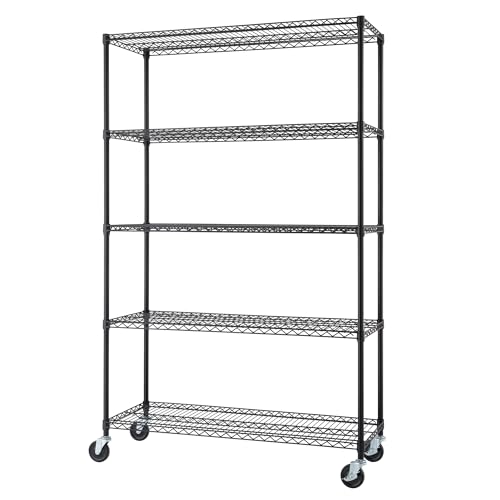 Trinity 5-tier outdoorTrinity publishes 500 lb per shelf on the feet levelers and 800 lb total on the wheels, and its NSF certification covers outdoor use rather than dry-only. For an unheated garage, a carport or a shed, that distinction is the whole reason to pick it. | The only one certified for damp and outdoor use | 500 lbper shelf on levelers | $141.99 · Check on Amazon |
| 4 |  VEVOR 5-tier 36 in.The least expensive unit on this page, and it still publishes the split: 400 lb a shelf, 2,000 lb total, on SPCC carbon steel with a powder coat. It assembles by hammer rather than by bolt, which is quick and permanent in roughly equal measure. | The cheapest unit here that still splits the rating | 400 lbper shelf, published | $48.36 · Check on Amazon-13% |
| 5 |  Amazon Basics 5-shelf rackFourteen inches deep, which is the point: it fits a wall where an 18 or 24 in unit would block the walkway or the car door. 350 lb a shelf and 1,750 lb total, published, with 1 in shelf increments and leveling feet. | The narrow-wall option | 14 indepth - the shallowest here | $58.79 · Check on Amazon-22% |
Every key number is a figure the manufacturer publishes. Where a maker publishes none, the row says so rather than substituting an estimate of ours.
Top pick · The heaviest published per-shelf figure here
Ironton 4-Tier Industrial Steel Shelving Unit, 77 in.
Two thousand pounds a shelf across four shelves, on a 77 in wide by 24 in deep frame - four times the per-shelf figure of the wire units here and the only one wide enough to take two storage bins end to end. Ironton publishes the split (2,000 per shelf, 8,000 total) rather than a single headline number.
- Body steel
- Not published
- Per shelf
- 2000 lb4 adjustable
- Storage
- Not published
- Empty weight
- Not published
What works
- 2,000 lb per shelf is four to six times what the wire racks here publish
- Publishes the per-shelf AND the total figure, so the split is not left to you
- 77 in wide is the widest unit here by a long way - fewer uprights across a wall
- Three cross braces per shelf, which is what lets wire decking carry a point load
What does not
- Publishes no steel gauge, so the 2,000 lb rests on steel of unstated thickness
- No published weight, which matters for a unit this size to move or ship
- Four shelves over 72 in means tall bays - fine for bins, wasteful for small items
- 24 in deep takes real floor space, and the back of a 24 in shelf is a reach
| Published specification | |
|---|---|
| Per-shelf capacity | 2,000 lb |
| Total capacity | 8,000 lb |
| Dimensions | 77 in W x 24 in D x 72 in H |
| Shelves | Four, height adjustable |
| Decking | Wire mesh, with 3 cross braces per shelf |
| Finish | Powder-coated steel |
| Steel gauge | Not published |
| Weight | Not published |
| Where it is sold | Amazon, plus other retailers |
Who it is for
A garage wall carrying genuinely heavy things - fluids, castings, wheels, bulk bins.
What it is not for
A narrow wall, or anyone who wants a published gauge behind the capacity.
2 · A third-party certification, not just a claim
Seville Classics UltraDurable 5-Tier NSF-Certified Steel Wire Shelving, 36 x 18 in.
Eight hundred pounds a shelf and 4,000 lb total on its leveling feet, and - unusually for anything on this site - certified to a third-party standard rather than self-declared. Read the configuration line carefully: Seville publishes just 500 lb total for the same unit on wheels.
- Body steel
- Not published
- Per shelf
- 800 lb5 adjustable
- Storage
- Not published
- Empty weight
- Not published
What works
- NSF/ANSI Standard 2 certification is a third-party test, not a marketing figure
- 800 lb per shelf is the highest of the wire racks here
- 1 in shelf increments, the finest adjustment on this page
- Publishes the wheels figure at all - most makers quietly leave that out
What does not
- On wheels the total drops to 500 lb, an eighth of the figure on feet - the headline number only applies on leveling feet
- The NSF certification is for DRY environments; this is not the outdoor unit
- No published steel gauge
- 36 in wide and 18 in deep is a modest footprint for the money
| Published specification | |
|---|---|
| Per-shelf capacity | 800 lb on leveling feet |
| Total capacity | 4,000 lb on leveling feet; 500 lb on wheels |
| Dimensions | 36 in W x 18 in D x 75 in H |
| Shelves | Five, adjustable in 1 in increments |
| Certification | NSF/ANSI Standard 2 - Food Equipment, for dry environments |
| Posts | 1 in diameter |
| Steel gauge | Not published |
| Where it is sold | Amazon, plus other retailers |
Who it is for
A dry garage or basement where a certified load figure is worth paying for.
What it is not for
Anywhere damp or outdoors, and any plan that involves putting it on casters loaded.
3 · The only one certified for damp and outdoor use
Trinity 5-Tier Outdoor NSF Wire Shelving Rack, 48 x 18 in. (NTBTGBK-0975)
Trinity publishes 500 lb per shelf on the feet levelers and 800 lb total on the wheels, and its NSF certification covers outdoor use rather than dry-only. For an unheated garage, a carport or a shed, that distinction is the whole reason to pick it.
- Body steel
- Not published
- Per shelf
- 500 lb5 adjustable
- Storage
- Not published
- Empty weight
- Not published
What works
- NSF certification that covers outdoor use, where the Seville's covers dry environments only
- 48 in wide, a foot more than the Seville, for similar money
- Both configurations published - 500 lb per shelf on feet, 800 lb total on wheels
- Casters included, and two of them brake
What does not
- 500 lb per shelf is well under the Seville's 800 and a quarter of the Ironton's
- Putting it on the included wheels caps the whole unit at 800 lb
- No published steel gauge
- Open wire shelves let small items through - bins or a liner are effectively required
| Published specification | |
|---|---|
| Per-shelf capacity | 500 lb on feet levelers, evenly distributed |
| Total on wheels | 800 lb, evenly distributed |
| Dimensions | 48 in W x 18 in D x 72 in H |
| Shelves | Five, adjustable |
| Certification | NSF certified for outdoor use |
| Casters | Four 4 in, two with brakes |
| Steel gauge | Not published |
| Where it is sold | Amazon, plus other retailers |
Who it is for
An unheated garage, carport or anywhere the air is damp.
What it is not for
Maximum per-shelf load, or storing small loose parts directly on the shelf.
4 · The cheapest unit here that still splits the rating
VEVOR 5-Tier Adjustable Storage Shelving Unit, 36 x 18 in.
The least expensive unit on this page, and it still publishes the split: 400 lb a shelf, 2,000 lb total, on SPCC carbon steel with a powder coat. It assembles by hammer rather than by bolt, which is quick and permanent in roughly equal measure.
- Body steel
- Not published
- Per shelf
- 400 lb5 adjustable
- Storage
- Not published
- Empty weight
- Not published
What works
- Publishes both the per-shelf and the total figure at the lowest price here
- Names the steel - SPCC carbon steel - which most budget shelving does not
- No-tool assembly, and the mallet is in the box
- 400 lb a shelf is more than enough for boxed goods and light tooling
What does not
- 38 mm shelf increments rather than the 1 in steps of the better wire racks
- Press-fit assembly is not meant to be taken apart and rebuilt repeatedly
- No published gauge, no published weight and no third-party certification
- Budget-tier fit and finish; check for shipping damage on arrival
| Published specification | |
|---|---|
| Per-shelf capacity | 400 lb |
| Total capacity | 2,000 lb |
| Dimensions | 36 in W x 18 in D x 72 in H |
| Shelves | Five, adjustable in 38 mm increments |
| Material | SPCC carbon steel, powder coated |
| Assembly | Press-to-assemble with the supplied rubber mallet; no tools |
| Steel gauge | Not published |
| Where it is sold | Amazon, plus other retailers |
Who it is for
A first set of garage shelves where the budget is the binding constraint.
What it is not for
Heavy point loads, damp environments, or a unit you expect to reconfigure often.
5 · The narrow-wall option
Amazon Basics 5-Shelf Adjustable Heavy-Duty Steel Wire Rack, 36 x 14 in.
Fourteen inches deep, which is the point: it fits a wall where an 18 or 24 in unit would block the walkway or the car door. 350 lb a shelf and 1,750 lb total, published, with 1 in shelf increments and leveling feet.
- Body steel
- Not published
- Per shelf
- 350 lb5 adjustable
- Storage
- Not published
- Empty weight
- Not published
What works
- 14 in deep clears a walkway that an 18 or 24 in unit would not
- Publishes per-shelf and total, like everything else here
- 1 in adjustment increments
- The cheapest way onto this page, and the easiest to put up
What does not
- 350 lb a shelf is the lowest figure here
- 14 in deep will not take a standard tote laid flat across it
- Chrome finish on a wire rack pits in a damp garage; this is a dry-space unit
- No published gauge and no certification
| Published specification | |
|---|---|
| Per-shelf capacity | 350 lb, evenly distributed |
| Total capacity | 1,750 lb |
| Dimensions | 36 in W x 14 in D x 72 in H |
| Shelves | Five, adjustable in 1 in increments |
| Feet | Four leveling feet |
| Assembly | No tools required |
| Steel gauge | Not published |
| Where it is sold | Amazon, plus other retailers |
Who it is for
A narrow garage wall, a laundry room or a basement where depth is the constraint.
What it is not for
Heavy loads, damp spaces, or storing large totes.
Sources for this entry
How we picked
- Per-shelf capacity, not the total. Nobody loads a shelving unit evenly. The heavy bin goes on one shelf, and the figure that matters is what that shelf carries. Every unit here publishes one, which makes this the best-documented category on the site.
- What the rating assumes. Two makers here publish a different, far lower total for the same unit on wheels than on leveling feet. A capacity quoted without its configuration is half a specification.
- Depth against your walkway. 14, 18 and 24 in are the depths on offer, and the choice is usually made by the car door rather than by the storage.
- Certification, where it exists. NSF/ANSI Standard 2 is a third-party test. Two units here carry it, and they carry different versions of it - one for dry environments, one for outdoor use.
- Shelf adjustment increment. 1 in steps let you size a bay to a tote. Coarser increments waste the difference.
What we did not do
Everyone in this category says they spent seventy-five hours testing tool chests. We have not opened any of these boxes, and we say so. What we do instead: compile the published specs, convert the steel gauges, multiply out the slide ratings, cite the maker’s own listing, and show the arithmetic so you can check it. The full method, including how to challenge a figure.
What each unit publishes
| Unit | Per shelf | Total | Size (W x D) | Certified? | Gauge |
|---|---|---|---|---|---|
| Ironton 4-tier | 2,000 lb | 8,000 lb | 77 x 24 in | No | Not published |
| Seville UltraDurable | 800 lb on feet | 4,000 lb on feet / 500 lb on wheels | 36 x 18 in | NSF/ANSI 2, dry | Not published |
| Trinity outdoor | 500 lb on levelers | 800 lb on wheels | 48 x 18 in | NSF, outdoor | Not published |
| VEVOR 5-tier | 400 lb | 2,000 lb | 36 x 18 in | No | Not published |
| Amazon Basics | 350 lb | 1,750 lb | 36 x 14 in | No | Not published |
Per-shelf figures are as published by each maker, evenly distributed. 'Not published' means we checked the maker's page and the figure is not there.
Not one of the five publishes a steel gauge, which is the reverse of job boxes, where four of five do. Shelving makers compete on load figures instead, and because those figures are per-shelf and comparable, that is arguably the better trade.
The wheels penalty, published
This is the finding worth the page. Seville publishes 800 lb per shelf and 4,000 lb total for its 5-tier rack on leveling feet. For the same rack on wheels, it publishes 500 lb total - not per shelf, total. That is one eighth of the figure on feet.
The casters are the limit, not the shelf
Trinity publishes the same pattern from the other direction: 500 lb per shelf on feet levelers, and 800 lb total on its wheels. Both makers are telling you that once a loaded rack has to roll, the constraint moves from the shelf to the casters and the frame's resistance to racking. If a listing quotes one big number and ships with casters in the box, that number is almost certainly the feet figure.
The practical rule: decide feet or wheels before you compare capacities, and compare like with like. A rack you will never move should be on its levelers, where the published numbers are several times higher and the unit does not rack under load. Casters, in detail covers what a caster rating does and does not include.
Depth is decided by the car, not the storage
The three depths here are 14, 18 and 24 inches, and the difference between them is a foot of garage.
- 14 in - the Amazon Basics. Fits beside a car in a single bay where nothing else will. Will not take a standard tote laid flat across it.
- 18 in - the Seville, Trinity and VEVOR. The general-purpose depth: totes fit, and a person can still walk past in most garages.
- 24 in - the Ironton. Takes two bins front to back, and takes a real bite out of the floor. Measure the walkway with the car parked before committing.
The same trade governs cabinets, and tool storage cabinets works through it for the door-and-shelf format - which is the same buying decision with a door added and per-shelf figures that run a good deal lower.
NSF certification, and the two versions of it
Two units here are NSF-certified, and it is not the same certification. Seville publishes NSF/ANSI Standard 2 - Food Equipment, for use in dry environments. Trinity publishes NSF certification for outdoor use.
That distinction decides which one belongs in an unheated garage. A dry-environment certification is a statement about where the finish was tested to survive, and a garage that condenses on cold mornings is not a dry environment in that sense. It is rare to get a third-party standard attached to anything in this category at all, so it is worth reading which standard you are getting.
Wire or solid decking
| Wire decking | Solid or mesh panel | |
|---|---|---|
| Small items | Fall through - bins required | Sit where you put them |
| Dust | Falls through rather than settling | Collects on the shelf |
| Light | Passes through to the shelf below | Shades what is under it |
| Point loads | Concentrated on a wire | Spread across the panel |
| On this page | Seville, Trinity, VEVOR, Amazon Basics | Ironton (wire mesh with 3 cross braces) |
For a garage, wire plus bins is usually the right answer: the bins solve the small-items problem and the open decking keeps the unit from becoming a dust shelf. The exception is heavy point loads, where cross-braced decking earns its keep.
Before you order
- Decide feet or wheels first, then read the capacity for that configuration and no other.
- Measure the walkway with the car in the bay, not the empty garage.
- Check the height against your ceiling - most of these are 72 to 75 in, and a garage door track can be lower than you think.
- Plan for bins if you are buying wire, and measure a tote against the shelf depth before ordering.
- In an unheated space, choose the outdoor-certified unit or a powder-coated one rather than chrome.
What we would skip
A list with no losers is a list nobody edited. These are the choices we would actively steer you away from, and why.
A unit quoting only a total capacity
A 3,000 lb headline tells you nothing about the shelf you are about to load, and dividing by the shelf count is not a substitute - it assumes an even load nobody actually uses. Every unit on this page publishes the split, so there is no reason to accept one that does not.
Chrome wire shelving in a damp garage
Chrome plating on wire shelving pits once condensation gets under it, and a garage that swings 30 degrees in a day produces condensation. If the space is unheated, buy the unit whose certification covers outdoor use, or a powder-coated one.
Loading a wheeled unit to its feet rating
This is the trap the page exists for. Seville publishes 4,000 lb total on leveling feet and 500 lb on wheels for the same unit. If you are going to roll it, the wheels figure is your figure.
Open wire shelves for small loose parts
Sockets, fasteners and anything round go straight through wire decking. Wire is for boxes, bins and bulky items; small parts belong in a parts organizer that then sits on the shelf.
The honest verdict
Buy the Ironton if the shelves will carry real weight and you have the 24 inches. Buy the Seville if the space is dry and you want a tested number behind the rating. Buy the Trinity if the space is damp, because its certification is the one that covers that. Buy the VEVOR or the Amazon Basics if the budget or the wall decides it - both publish their split honestly, and the Amazon Basics is the only unit here shallow enough for a genuinely tight bay.
Whichever you pick, the number to write down is the per-shelf figure for the configuration you will actually use. In this category, unusually, every maker gives it to you.
Common questions
What is the best garage shelving?
For heavy loads, the Ironton 4-tier unit: a published 2,000 lb per shelf and 8,000 lb total on a 77 x 24 in frame. For a dry garage, the Seville Classics UltraDurable 5-tier at 800 lb per shelf, NSF/ANSI Standard 2 certified. For a damp or unheated space, the Trinity 5-tier, whose NSF certification covers outdoor use.
How much weight can garage shelving hold?
Published per-shelf figures on the units here run from 350 lb to 2,000 lb, evenly distributed. Use the per-shelf number rather than the total: nobody loads a rack evenly, and the total assumes you do. Check which configuration the figure applies to, because two of these makers publish a much lower total for the same unit on wheels.
Why does shelving hold less on wheels?
Because the casters and the frame's resistance to racking become the limit rather than the shelf. Seville publishes 4,000 lb total on leveling feet and 500 lb on wheels for the same 5-tier rack. Trinity publishes 500 lb per shelf on feet levelers and 800 lb total on its wheels. Decide feet or wheels before comparing any capacity figures.
How deep should garage shelving be?
Depth is usually decided by the walkway, not the storage. 14 in fits beside a car in a tight single bay but will not take a standard tote laid flat. 18 in is the general-purpose depth and takes totes. 24 in holds two bins front to back and takes a real bite out of the floor - measure with the car parked before choosing it.
Is wire or solid shelving better for a garage?
Wire plus bins suits most garages: dust falls through instead of settling, and the bins solve the problem of small items dropping between the wires. Solid or cross-braced mesh decking is better for heavy point loads and for anything small enough to fall through.
Read next
Tool storage cabinets, for everything a drawer cannot hold
Doors and shelves rather than drawers, for the cases, pails and cordless kits a chest cannot hold - compared on published shelf capacity and adjustability.
Small parts organizers, and the one that suits how you work
Parts cabinets, sealed bin organizers and tray inserts - three formats for three different problems, compared on published compartment size.
The best job boxes, and why they use thicker steel than your tool chest
Five jobsite boxes compared on published steel gauge, volume, weight and lock hardware - and the one that says how much it holds.
Casters: the component that decides whether the box moves
Load per caster worked out, why diameter is about obstacles rather than weight, and how to move several hundred pounds without tipping it.
Tool storage ideas, in the order that actually pays off
A sequence rather than a gallery: what to fix first, what each format is good at, and the published limits that decide which one your problem needs.