Sorting without a blade
Tool box drawer dividers, and what they give up to cut foam
Dividers sort a drawer in ten minutes and can be rearranged on a whim. Foam takes an afternoon and shows you instantly which tool is missing. Both are right, for different people.

If the drawer belongs to a system with its own dividers - Klein's MODbox, for instance - buy those, because they were sized for that drawer. Otherwise buy expandable trays, which adjust to the drawer you own. Both sort a drawer in minutes; neither gives you the missing-tool signal that cut foam does.
Dividers against foam, honestly
These are the two ways to organize a tool drawer and they solve overlapping but different problems.
| Dividers and trays | Cut foam | |
|---|---|---|
| Time to fit | Ten minutes | An afternoon per drawer, with a sharp blade |
| Missing tool | You notice eventually | A tool-shaped hole, immediately |
| Changing your mind | Move a divider | Cut a new sheet |
| Tools sliding | Contained by compartment, still loose in it | Held in a pocket, silent |
| Drawer depth used | Tray walls, typically 1-2 in | Foam thickness, typically 1-2 in |
| Cost per drawer | Low | Higher, and rises with box size |
The honest sequence for most people is dividers first, foam later: sort the drawer cheaply, live with it for a few months, and only commit to cut foam for the two or three drawers whose layout has stopped changing. Drawer foam covers that second step, and how to organize a tool chest covers the order the whole job should happen in.
Quick picks
Ranked on published specifications, not on hype. The key number is the figure that decides each pick, quoted from the maker. Tap a row for the full write-up, or go straight to the listing.
| # | Product | Best for | Key number | Price |
|---|---|---|---|---|
| 1 |  Klein MODbox dividersTwenty-four pieces designed around Klein's own MODbox drawers rather than trimmed to fit whatever you own. That is the trade with dividers generally: a set cut for a known drawer fits properly, and a universal set fits everything approximately. | Dividers designed for a specific drawer | 24pieces, three drawer configs | $19.99 · Check on Amazon |
| 2 | 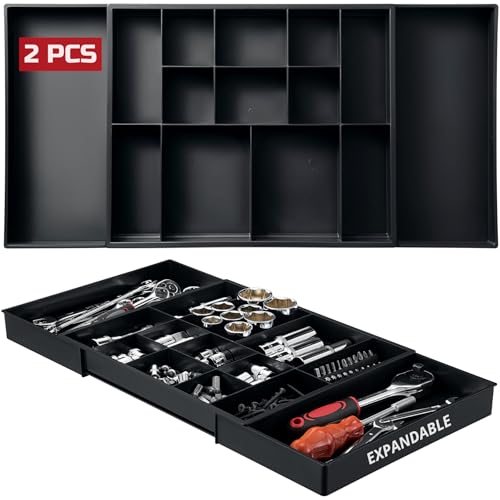 ONREVA expandable traysExpandable trays are the universal answer to a problem foam solves precisely: they stretch to the drawer rather than being cut to it. You lose the tool-shaped pocket and you gain the ability to change your mind on a Sunday afternoon. | Expanding to fit the drawer you actually own | Expandableto drawer width | $26.99 · Check on Amazon |
| 3 |  BrightRow trays, 2-packTwo expandable trays with a published 12+2 compartments each, which is enough to sort two drawers for less than a single sheet of shadow foam costs. The compartment count is the only figure published, and in this category that is normal. | Two drawers done for one price | 12+2published compartments | $25.99 · Check on Amazon |
Every key number is a figure the manufacturer publishes. Where a maker publishes none, the row says so rather than substituting an estimate of ours.
Top pick · Dividers designed for a specific drawer
Klein Tools MODbox Drawer Dividers, 24-Piece (54923MBR)
Twenty-four pieces designed around Klein's own MODbox drawers rather than trimmed to fit whatever you own. That is the trade with dividers generally: a set cut for a known drawer fits properly, and a universal set fits everything approximately.
- Body steel
- Not published
- Per drawer
- Not published
- Storage
- Not published
- Empty weight
- Not published
What works
- Sized for a specific drawer, so the dividers actually meet the walls
- Three configurations out of one set
- Reconfigurable in seconds, unlike cut foam
- From the maker of the box, so the fit is not a guess
What does not
- Built around MODbox drawers - in another box you are back to approximate fit
- No published material or load detail
- Dividers do not stop tools sliding the way foam does; they stop them mixing
- Stock on this item has been thin
| Published specification | |
|---|---|
| Pieces | 24 |
| Configurations | Three drawer configurations |
| Designed for | Klein MODbox drawers |
| Adjustable | Yes |
| Material | Not published in detail |
| Where it is sold | Amazon, plus other retailers |
Who it is for
MODbox owners, and anyone who wants dividers that were designed for a real drawer.
What it is not for
A random tool chest drawer, where a universal tray set fits better.
Sources for this entry
2 · Expanding to fit the drawer you actually own
ONREVA Expandable Tool Box Organizer Tray and Divider Set
Expandable trays are the universal answer to a problem foam solves precisely: they stretch to the drawer rather than being cut to it. You lose the tool-shaped pocket and you gain the ability to change your mind on a Sunday afternoon.
- Body steel
- Not published
- Per drawer
- Not published
- Storage
- Not published
- Empty weight
- Not published
What works
- Expands to the drawer you own rather than needing a specific box
- Reconfigurable in seconds - no blade, no afternoon, no commitment
- Cheaper than foam for a whole box
- Keeps categories separate, which is most of the benefit of organizing a drawer
What does not
- No tool-shaped pocket, so a missing tool is not visible the way it is in cut foam
- Expandable joints are the weak point and they rattle in a drawer that gets slammed
- No published material or load figures
- Trays take drawer height that foam does not
| Published specification | |
|---|---|
| Type | Expandable organizer trays with dividers |
| Fits | Adjusts to drawer width |
| Load rating | Not published |
| Material | Not published in detail |
| Piece count | Set - see listing for the current count |
| Where it is sold | Amazon, plus other retailers |
Who it is for
Someone who wants a drawer sorted this afternoon and may rearrange it later.
What it is not for
The missing-tool signal - cut foam is what does that.
Sources for this entry
3 · Two drawers done for one price
BrightRow Expandable Tool Box Organizer Tray, 2-Pack
Two expandable trays with a published 12+2 compartments each, which is enough to sort two drawers for less than a single sheet of shadow foam costs. The compartment count is the only figure published, and in this category that is normal.
- Body steel
- Not published
- Per drawer
- Not published
- Storage
- Not published
- Empty weight
- Not published
What works
- Two trays in the box, so two drawers get sorted at once
- Publishes its compartment count clearly
- Expandable, so no measuring before ordering
- The cheapest way here to bring order to a chaotic drawer
What does not
- Publishes nothing beyond the compartment count
- Fixed compartment sizes will not suit every tool
- Plastic trays slide in a drawer unless the drawer is lined
- No missing-tool signal, as with any tray system
| Published specification | |
|---|---|
| Compartments | 12 + 2 per tray |
| Supplied | 2-pack |
| Fits | Expandable to drawer width |
| Load rating | Not published |
| Material | Not published in detail |
| Where it is sold | Amazon, plus other retailers |
Who it is for
Two messy drawers and a small budget.
What it is not for
Precision layout, or heavy tools that need the drawer's full depth.
Sources for this entry
How we picked
- Does it fit YOUR drawer? A divider set cut for a specific box meets the walls properly. A universal set expands to approximately the right width. That difference is most of the quality gap in this category.
- Reconfigurable or committed? This is the whole reason to choose dividers over foam. If you will never rearrange the drawer, foam is better; if you are still working out the layout, dividers are.
- Compartment count against your tools. Published, and the only figure any of these makers gives you.
- Height cost. Trays and dividers take drawer depth just as foam does. A shallow drawer cannot afford much of either.
- Does it slide? A plastic tray in a bare steel drawer slides every time the drawer opens. A liner underneath fixes it.
What we did not do
Everyone in this category says they spent seventy-five hours testing tool chests. We have not opened any of these boxes, and we say so. What we do instead: compile the published specs, convert the steel gauges, multiply out the slide ratings, cite the maker’s own listing, and show the arithmetic so you can check it. The full method, including how to challenge a figure.
Fitted beats universal, when you can get it
A divider set designed around a particular drawer meets the drawer walls, so the compartments are actually closed. A universal set expands until it is roughly the right width, and whatever gap is left is where small sockets go to live.
Klein's MODbox dividers are the example here: twenty-four pieces in three configurations, built around Klein's own drawers. If your storage is part of a system with matching dividers, that is almost always the better buy. If it is a generic chest, expandable trays are the practical answer and the fit will be approximate.
What none of them publish
A compartment count, and nothing else. No maker here publishes a material specification, a load figure, or dimensions beyond what the listing photograph implies.
Why that matters less here than elsewhere
For a drawer divider it genuinely does not matter much - nothing structural depends on it, and the failure mode is a cracked plastic wall rather than a dropped tool. It is worth naming anyway, because the same absence on a slide or a shelf would be disqualifying, and this site tries to be consistent about what is published and what is not.
Setting a drawer up so it stays that way
- Liner first, always. A sheet of drawer liner under the trays stops the whole layout sliding on every open.
- Group by task, not by tool type. The things you reach for together should be in the same compartment, even if they are different kinds of tool.
- Leave one compartment empty. Every drawer accumulates the thing you have not decided about yet.
- Heaviest at the bottom of the box, not just the front of the drawer - the drawer's weight affects how the whole chest behaves. The drawer arithmetic covers that.
- Wait before committing to foam. Three months of use will tell you which drawers have a settled layout.
What we would skip
A list with no losers is a list nobody edited. These are the choices we would actively steer you away from, and why.
Dividers, if you want the missing-tool signal
The single best thing cut foam does is show a tool-shaped hole when something is not returned. No divider system does that - it keeps categories apart, which is a different and lesser benefit. If the signal is what you want, that is drawer foam.
Universal dividers in a drawer you will never change
If the layout is settled and the box is staying, foam cut to your tools is neater, quieter and more useful. Dividers are the right answer while the layout is still moving.
Trays in a shallow drawer
A tray with 2 in walls in a 3 in drawer leaves you an inch of usable depth. Shallow drawers want liner and shallow trays at most; the deep drawers are where dividers earn their keep.
Plastic trays on bare steel
They slide on every open and close, which is the noise and the mess you were trying to fix. Put a drawer liner underneath - it costs very little and it stops the whole system moving.
The honest verdict
Dividers are the cheap, fast, reversible way to make a drawer usable, and for most people in most drawers they are the right call. Buy the fitted set if your box has one. Buy expandable trays if it does not, and put a liner underneath. Then leave foam for the two drawers that have earned it.
Common questions
Are drawer dividers better than foam for a tool box?
They are faster, cheaper and reversible, and for a drawer whose layout is still changing they are the better choice. Foam is better once the layout is settled, because a tool-shaped pocket shows instantly when something has not been put back - no divider system does that.
Do drawer dividers fit any tool box?
Expandable trays adjust to most drawer widths, with an approximate fit. Divider sets designed for a specific system - Klein's MODbox dividers, for example - fit that system's drawers properly and fit anything else approximately. Fitted beats universal where you can get it.
How do I stop drawer trays sliding around?
Put a non-slip drawer liner underneath. Plastic trays on bare steel slide on every open and close, which is the noise and disorder you were trying to remove. A liner roll costs very little and fixes it completely.
How much drawer depth do dividers take?
Typically 1 to 2 in of wall height, which is comparable to foam. In a deep drawer that is irrelevant; in a 3 in drawer it is most of your usable space. Shallow drawers are better served by liner alone or by very shallow trays.
Sources
Read next
Drawer foam, and the one thing it does that liner cannot
What foam does that liner cannot, what it costs in drawer depth, and which drawers are actually worth the afternoon.
Drawer liner: ten minutes, the whole box, do it on day one
The cheapest and first upgrade for any new chest: what sliding actually costs, and how to line a whole box in ten minutes.
Socket organizers, for the worst drawer in any tool box
Why sockets are the worst-behaved thing in any drawer, and an honest comparison of trays, rails, foam and magnets.
How to organize a tool chest, in the order that works
Frequency decides the height, weight decides the depth, and the buying order that puts foam last for a reason.
What your drawer actually weighs, and what the box weighs full
The calculator for your own heaviest drawer, published tool weights, and the loaded-box figure no manufacturer prints.