The pre-purchase doubt
Is PACKOUT worth it? Three questions that answer it for you
PACKOUT costs roughly double a plain tool box of the same volume. Whether that is worth paying comes down to how often you move tools, how many boxes you will end up owning, and whether the IP65 rating is doing anything for you.
Worth it if your tools move regularly and you will own four or more pieces. The cleats, the rolling base and the IP65 seal are what you are paying for, and all three only earn their money in transit. Not worth it for a fixed workshop, for a single box, or if you already own ToughSystem or StackTech - the systems do not interoperate.
What the premium actually buys
Strip away the marketing and PACKOUT sells four things a plain tool box does not have.
- Locking cleats. Boxes join into one rigid stack that moves as a single object. This is the feature, and everything else is secondary to it.
- A published IP65 seal on the hard cases. A defined test: total dust ingress protection, plus protection against low-pressure water jets from any direction.
- An impact-resistant shell, which matters in a truck bed and does nothing on a shelf.
- Range. More compatible boxes, organizers, bags, racks and mounts than any competing system, which is the thing that compounds over years.
None of those is storage. You are not buying volume - a plain plastic tool box of the same external size holds broadly the same tools for roughly half the money. You are buying the ability to move six boxes in one trip without carrying six boxes.
Quick picks
Ranked on published specifications, not on hype. The key number is the figure that decides each pick, quoted from the maker. Tap a row for the full write-up, or go straight to the listing.
| # | Product | Best for | Key number | Price |
|---|---|---|---|---|
| 1 | 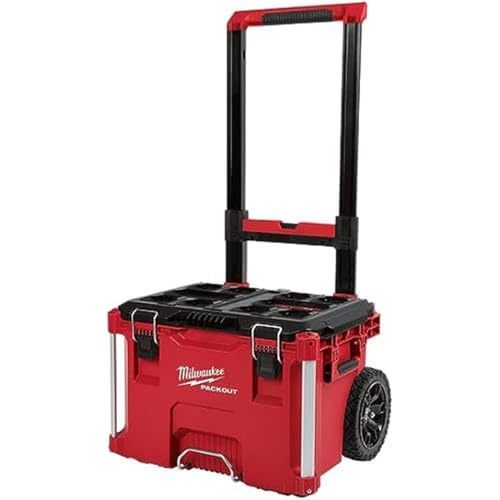 PACKOUT rolling tool boxMilwaukee publishes two capacities and both are worth knowing: 250 lb while you are rolling it, 1,000 lb standing still. Every other PACKOUT component clips to it, which is the actual product being sold. | The base of the largest modular ecosystem | 250 lbdynamic capacity | $215.00 · Check on Amazon |
| 2 | MilwaukeeNo photo PACKOUT compact organizerFive removable bins under a transparent sealing lid, IP65 rated, and it clips into the rest of a PACKOUT stack. The bins come out and go to the work, which is the whole point of a small-parts organizer. | Small parts inside a PACKOUT stack | IP65weather seal | Check price on Amazon |
| 3 | 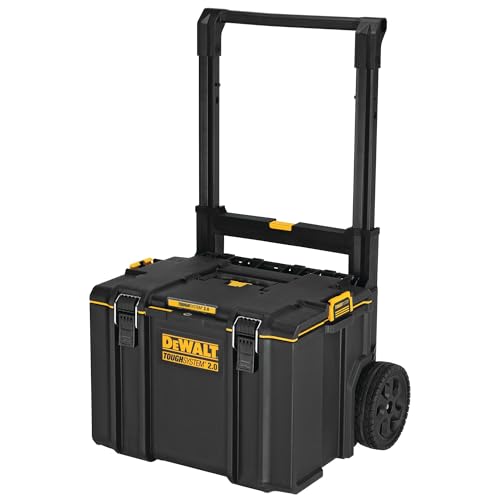 ToughSystem 2.0 rolling boxMatches PACKOUT's 250 lb and IP65 with one advantage Milwaukee cannot offer: it is backward compatible with every earlier ToughSystem box, so an existing collection is not stranded. | The PACKOUT alternative that is backward compatible | 250 lbload capacity | $125.00 · Check on Amazon |
Every key number is a figure the manufacturer publishes. Where a maker publishes none, the row says so rather than substituting an estimate of ours.
Top pick · The base of the largest modular ecosystem
Milwaukee PACKOUT Rolling Tool Box (48-22-8426)
Milwaukee publishes two capacities and both are worth knowing: 250 lb while you are rolling it, 1,000 lb standing still. Every other PACKOUT component clips to it, which is the actual product being sold.
- Body steel
- Not published
- Per drawer
- Not published
- Storage
- Not published
- Empty weight
- Not published
What works
- Publishes a dynamic AND a static capacity, which almost nobody in modular storage does
- 9 in wheels handle a gravel driveway and a curb, not just a shop floor
- The largest component range of any modular system, so the base has somewhere to grow
- IP65 means rain on a truck bed is not a problem
What does not
- 250 lb dynamic is the real ceiling and a loaded stack passes it easily
- You are buying into an ecosystem: leaving it later means replacing the whole stack
- Sold through many channels, so the Amazon listing is not always the best price
| Published specification | |
|---|---|
| Dynamic capacity | 250 lb (in motion) |
| Static capacity | 1,000 lb (stationary) |
| Wheels | 9 in all-terrain |
| Handle | 19.75 in fully collapsible |
| Weather | IP65-rated seal |
| Connection | Integrated locking cleats, compatible with all PACKOUT components |
| Where it is sold | Amazon, plus other retailers |
Who it is for
Anyone whose tools travel - job site, driveway, or a second garage.
What it is not for
A fixed garage bay, where a steel cabinet gives far more storage per dollar.
Sources for this entry
2 · Small parts inside a PACKOUT stack
Milwaukee PACKOUT Compact Organizer (48-22-8435)
Five removable bins under a transparent sealing lid, IP65 rated, and it clips into the rest of a PACKOUT stack. The bins come out and go to the work, which is the whole point of a small-parts organizer.
- Body steel
- Not published
- Per drawer
- Not published
- Storage
- Not published
- Empty weight
- Not published
What works
- IP65 on a small-parts box is unusual and genuinely useful in an open truck bed
- Removable bins go to the work instead of the whole box going
- Transparent lid means you identify the box without opening it
- Clips into a PACKOUT stack rather than riding loose on top of it
What does not
- No published weight capacity for the organizer itself
- Only worth it if you are already inside the PACKOUT system - the cleats fit nothing else
- Five bins is a shallow subdivision compared with a 64-drawer parts cabinet
| Published specification | |
|---|---|
| Bins | 5 removable storage bins |
| Lid | Transparent, seals the bins so contents cannot migrate in transport |
| Weather | IP65 rated seal |
| Construction | Impact-resistant |
| System | PACKOUT; mounts and stacks with the rest of the range |
| Where it is sold | Amazon, plus other retailers |
Who it is for
A PACKOUT owner who needs fasteners and terminations to travel sorted and dry.
What it is not for
A stationary garage, where a wall-mounted parts cabinet holds far more for less.
Sources for this entry
3 · The PACKOUT alternative that is backward compatible
DeWalt ToughSystem 2.0 Rolling Toolbox (DWST08450)
Matches PACKOUT's 250 lb and IP65 with one advantage Milwaukee cannot offer: it is backward compatible with every earlier ToughSystem box, so an existing collection is not stranded.
- Body steel
- Not published
- Per drawer
- Not published
- Storage
- Not published
- Empty weight
- 20.61 lb10 lb per caster, empty
What works
- Backward compatible with the older ToughSystem line, which PACKOUT is not
- Auto-connect side latches work one-handed
- Two-piece metal front latches rather than all-plastic
- 20.61 lb empty is light for the size
What does not
- 8 in wheels rather than PACKOUT's 9 in over rough ground
- Smaller accessory range than PACKOUT
- 250 lb is the whole stack, not per box
| Published specification | |
|---|---|
| Load capacity | 250 lb |
| Weather | IP65 dust and water resistant |
| Wheels | 8 in |
| Dimensions | 23-7/8 in W x 19-5/8 in L x 16-5/8 in H to lid |
| Handle | 26-5/8 in stowed, 38-7/8 in extended |
| Weight | 20.61 lb |
| Compatibility | Backward compatible with earlier ToughSystem products |
| Where it is sold | Amazon, plus other retailers |
Who it is for
Anyone already holding ToughSystem boxes, and anyone who wants IP65 on a budget.
What it is not for
A buyer starting fresh who wants the widest possible accessory range.
Sources for this entry
How we picked
- How often do the tools move? The cleats, the shell and the rolling base are all costs that only pay back if the stack travels. A box that lives under a bench gets nothing from any of them.
- How many boxes will you own in three years? A modular system's value is superlinear in box count - one box is an expensive tool box, five boxes is a system that carries itself in one trip.
- Is the IP65 rating worth anything to you? It is a real, defined test. It is also irrelevant in a dry garage, and Milwaukee does not publish it on every PACKOUT product.
- What do you already own? The cleats do not interoperate with ToughSystem or StackTech. If you own one of those, the honest answer is usually to keep buying it.
- Do you need drawers? PACKOUT's drawer options are narrower than what ToughBuilt StackTech offers, and drawers are the thing people miss most after a year.
What we did not do
Everyone in this category says they spent seventy-five hours testing tool chests. We have not opened any of these boxes, and we say so. What we do instead: compile the published specs, convert the steel gauges, multiply out the slide ratings, cite the maker’s own listing, and show the arithmetic so you can check it. The full method, including how to challenge a figure.
The arithmetic that decides it
The system premium is roughly fixed per box. The benefit is not: it scales with how many boxes are clipped together and how often the stack moves.
| What you own | What the cleats give you | Honest verdict |
|---|---|---|
| One box | Nothing. There is nothing to clip to. | Poor value. Buy a plain tool box. |
| Two boxes | One trip instead of two | Marginal. The premium is still doing little. |
| Three or four, on a rolling base | The whole kit moves as one object, on wheels | This is where it starts to make sense. |
| Five or more, plus organizers and a bag | A complete, reconfigurable kit that loads in one lift | The case for the system, and it is a strong one. |
A qualitative view of how the value changes with box count. No prices are quoted here - live prices are on the pick cards above.
Which is why the single worst way to buy into PACKOUT is one box at a time to 'see how it goes'. The first box is the one that delivers least and costs most relative to its alternative.
IP65: real, tested, and often irrelevant
What IP65 certifies
6 is the top solids rating: dust-tight, no ingress at all. 5 is protection against low-pressure water jets from any direction. It is a genuine test and a genuinely good result - considerably better than the IP54 that appears on the best-rated tool bags. It is also worth precisely nothing if the box lives in a dry garage.
The honest framing: IP65 is a reason to choose PACKOUT over a cheaper hard case if the boxes ride in an open truck bed or sit on a site in the rain. It is not a reason to pay a premium for a box that goes from the garage to the driveway. And it does not apply to the fabric products - Milwaukee publishes no IP rating on the PACKOUT totes and bags, for the obvious reason.
The three cases where the answer is clearly no
You already own ToughSystem or StackTech. The cleats do not interoperate and there is no adapter. Switching means rebuying the stack, and the system you own is almost certainly good enough - PACKOUT and ToughSystem publish nearly identical headline specs and differ mainly in how the boxes latch.
The tools never leave the building. A fixed workshop wants storage volume and drawers, and modular cases are poor at both relative to their cost. Tool chest versus PACKOUT works the comparison through properly: they answer two different questions and only one of them is 'where do I keep my tools'.
You mainly want drawers. PACKOUT's drawer options exist but are narrow. ToughBuilt StackTech built its case on offering drawers the big two mostly do not, and if drawers are the priority that is the honest place to look first.
If the answer is yes, buy it in this order
- The rolling box first. It is the base of the stack and the thing that makes everything above it mobile. Buying organizers before the base is the common mistake.
- A large box or a tote next, for the bulky things - cordless tools, a drill and its batteries.
- Then organizers, sized to the fasteners and small parts you actually carry rather than to the drawer you imagine.
- A bag last, if at all. It is the piece that works least well outside the system and is easiest to substitute.
The full PACKOUT breakdown goes through the range on Milwaukee's own published figures, and how to choose a stacking system is the page to read if you have not committed to a system at all yet - because that decision outlasts every box you buy.
What we would skip
A list with no losers is a list nobody edited. These are the choices we would actively steer you away from, and why.
Buying one PACKOUT box to 'try the system'
A single box is the worst possible value in the range - you pay the system premium and get none of the system benefit. Either commit to three or four pieces or buy a plain tool box, which will be cheaper and, on its own, just as good.
PACKOUT for a workshop that never moves
In a fixed shop you are paying for cleats, a weather seal and an impact shell, none of which do anything. The same money in a steel cabinet buys several times the storage volume and drawers that run on ball-bearing slides.
Mixing PACKOUT with another modular system
PACKOUT, ToughSystem and StackTech cleats are mutually incompatible. Half a stack in each system is the worst outcome available: you get the premium of both and the convenience of neither.
Assuming every PACKOUT product is IP65
Milwaukee publishes IP65 on the hard cases. It publishes no IP rating at all on the fabric totes and bags - and the absence is deliberate, because a bag with an open mouth cannot be sealed. Check the product, not the brand.
The honest verdict
PACKOUT is worth it for people whose tools travel and who will own a real stack. It is a poor buy for everyone else, and Milwaukee's own specifications are what say so: nothing in the premium is storage volume, and everything in it is about movement and weather.
If your tools do not move and do not get rained on, you are being asked to pay for two features you will never use. That is not a criticism of the system - it is the wrong system for the job.
Common questions
Is Milwaukee PACKOUT worth it?
Yes if your tools move regularly and you will own four or more pieces - the locking cleats, the rolling base and the published IP65 seal on the hard cases all earn their money in transit. No for a fixed workshop, no for a single box, and no if you already own ToughSystem or StackTech, because the cleats do not interoperate.
Is PACKOUT waterproof?
The hard cases carry a published IP65 rating, which is dust-tight plus protection against low-pressure water jets from any direction. That is a real tested result, not an adjective. It does not extend to the fabric totes and bags, where Milwaukee publishes no IP rating at all.
Is one PACKOUT box worth buying?
Not really. A single box is the worst value in the range: you pay the system premium and get none of the system benefit, because there is nothing to clip it to. Either commit to three or four pieces on a rolling base, or buy a plain tool box for roughly half the money.
Should I buy PACKOUT or a tool chest?
They answer different questions. A tool chest is storage - far more volume and ball-bearing drawers for the money. PACKOUT is transport - it moves a kit to a job and back. If the tools live in one place, buy the chest.
Can PACKOUT connect to DeWalt ToughSystem?
No. The locking cleats are proprietary to each system and there is no adapter. Owning half a stack in each is the worst outcome available, so pick one system and stay in it.
Sources
Read next
Milwaukee PACKOUT, explained by its own specification sheet
How PACKOUT works, what its two published capacities mean, what IP65 covers, and which piece to buy first.
How to pick a stacking system you will not regret
Three questions in order, the weight table that decides which systems are even eligible, and the switching cost nobody puts in a comparison.
PACKOUT vs ToughSystem 2.0: identical headline specs, one real difference
Identical headline specs, one real difference: backward compatibility against range size, and the dynamic-versus-static trap in between.
Tool chest vs PACKOUT: two answers to two different questions
Storage per dollar against portability, with the numbers laid out and one question that decides which you should buy.
Best modular tool storage systems, on the numbers they publish
Five systems compared on published dynamic capacity, weather rating and range size, with the 50 lb versus 250 lb gap that decides it.